
In December 2009, an obscure independent filmmaker in Milwaukee sat at a cluttered desk, opened Sony Vegas, and began slicing a seventy-minute movie critique into ten-minute pieces. The platform was YouTube, which at the time enforced a strict ten-minute limit on uploads. The video was a raspy, bizarre, extraordinarily thorough teardown of a science fiction blockbuster. The graphics were ugly. The microphone was cheap. Yet millions of people watched every second, captivated by an obsessive lesson in pacing, tone, and character motivation. The rise of video essayists began right there in the messy corners of Web 2.0, turning suburban bedrooms into film school classrooms.
Today, that scrappy practice looks nothing like its origins. Creators spend six months researching a single production, booking soundstages, hiring composers, and grading archival footage in high definition. What once felt like bedroom chatter has transformed into an ambitious, independent wing of cinematic documentary. The rise of video essayists reshaped how audiences watch movies, challenge corporate studios, and interpret modern culture. To understand how a shaky hobby grew into an art form, we need to trace the trail of clipped celluloid, copyright strikes, and creative epiphanies that got us here.
The numbers behind this cultural shift tell an astonishing story about audience appetite for deep cinematic criticism:
32 million views
The global viewership recorded for Hbomberguy’s four-hour investigative film critique, as documented in the annual survey by the
British Film Institute’s Sight and Sound
.
36 minutes
The average runtime of YouTube video essays nominated in international film polls by 2024, more than tripling the average runtime of festival submissions on Vimeo, according to the British Film Institute.
28 original essays
The total canonical library produced by Taylor Ramos and Tony Zhou for their landmark channel, a body of work that later earned preservation and distribution through
.
10 minutes
The rigid video duration ceiling imposed on standard web creators by YouTube until late 2010, which fundamentally dictated the structural editing of early internet film critics, as recorded by CNET.
1998–2008: Analog Ghosts and the Desktop Spark
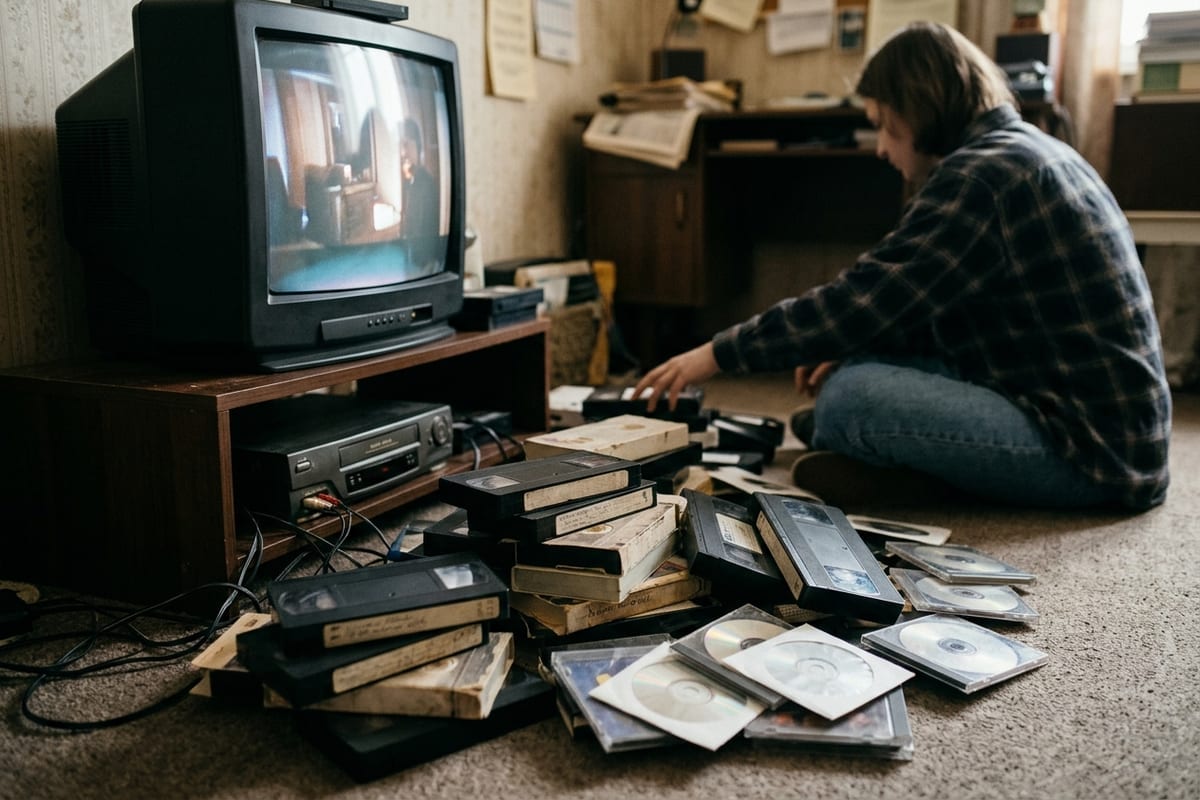
Before digital video files lived on hard drives, film criticism lived almost entirely on paper. If a writer wanted to talk about how Alfred Hitchcock cut between a screaming face and a draining shower, they had to describe the images using ink. They relied on the reader’s memory. If you had not seen the movie, or if you had forgotten the exact composition of a close-up, the critic’s argument remained abstract. Film scholars occasionally made documentary films using celluloid, but the process was agonizingly expensive. You needed archival licenses, optical printers, and editing suites that cost more than a family home.
The French New Wave pioneer Jean-Luc Godard saw the horizon early. Between 1988 and 1998, Godard released his monumental multi-part project, an eight-part visual essay composed of archival clips, voiceovers, paintings, and discordant musical cues. Godard did not merely write about cinema. He thought through cinema, using images to question other images. Around the same time, experimental essayists like Chris Marker were proving that a movie could function like an open letter or a philosophical journal. These projects were brilliant, but they remained sequestered in cinematheques and specialized film festivals. Everyday cinephiles could admire the work, but they could not easily make it.
The Digital Millennium Copyright Act and the DVD Drive
Everything changed when the DVD-ROM drive met consumer desktop computers. In 1999, Norwegian teenager Jon Lech Johansen and his collaborators wrote software that bypassed the content scrambling system on commercial DVDs. Suddenly, movies were not untouchable plastic platters locked inside home television sets. They were digital files. You could extract a frame. You could rip a scene. You could drop a pristine digital copy of a classic thriller into an affordable non-linear editing software program like Apple’s Final Cut Pro or Sony Vegas.
Scholars and cinephiles immediately recognized the educational power of this shift. In 2007, media professor Eric Faden created a short educational video analyzing intellectual property, using hundreds of spliced clips from classic animated features. Faden’s project proved that copyrighted media could be reassembled under the doctrine of fair use to teach audiences complex concepts. Legal frameworks supported this educational work, as defended by advocacy groups like the Electronic Frontier Foundation, establishing that using excerpts for critique, parody, and commentary represents protected free expression.
At the exact moment home video became malleable, the early web provided a public theater. Platforms like Blip.tv and Vimeo launched alongside YouTube in the mid-2000s. Early critics began experimenting with short desktop clips, syncing recorded voiceovers to digital video rips. The visual quality was rough. Compression artifacts turned deep black backgrounds into muddy grey blocks. The sound was often tinny. But the basic grammar of the modern video essay was quietly taking root.
2009–2013: Web Video Growing Pains and the Ten-Minute Ceiling
The dawn of the 2010s was a wild, unruly era for web video. Creators worked under brutal technical constraints. YouTube capped standard video uploads at 100 megabytes and ten minutes in length. If you had a twenty-minute idea, you had to chop it in half, upload it as “Part 1” and “Part 2,” and beg your viewers to click through an interactive annotation box in the upper right corner of the screen. High-definition video was rare. Buffering wheels spun endlessly on home DSL connections.
[[COMIC: A cartoon hand repeatedly tapping an upload button while an hourglass timer spins slowly | comic | computer loading cartoon]]
During this period, internet film commentary split into two completely different camps. On one side stood the loud, exaggerated internet characters popularized by early web networks. These reviewers yelled at the camera, donned goofy costumes, and staged living room skits to roast terrible movies from their childhoods. The analysis was often shallow, built around jokes and plot recaps rather than formal film grammar. Yet it taught millions of young viewers that talking back to movies was fun.
The Harry S. Plinkett Phenomenon
In late 2009, Mike Stoklasa of the Milwaukee-based production house RedLetterMedia took that amateur energy and turned it inside out. Adopting the fictional persona of Harry S. Plinkett, an unhinged senior citizen mumbling into a microphone, Stoklasa released a comprehensive breakdown of the 1999 prequel to a beloved galactic space saga. The humor was dark, absurd, and intentionally grating. But underneath the goofy persona lay an airtight, master-level seminar on classic film direction.
Stoklasa spent over an hour explaining the invisible craft of cinema. He pulled up side-by-side comparisons of camera angles. He demonstrated why reverse-angle conversation shots keep audiences oriented in a room. He challenged viewers to describe the personalities of the main characters without mentioning their costumes or professions. For an entire generation of film fans who had never read a page of screenwriting theory, the Plinkett reviews were an eye-opener. Viewers realized that a movie’s failure often stems from structural neglect, emotional emptiness, and visual laziness. Stoklasa showed that long-form internet criticism could be more entertaining and insightful than whatever was playing in local theaters.
Kevin B. Lee and the Desktop Documentary
While internet fan cultures were obsessing over space blockbusters, a quieter movement was happening in the independent film community. Critic and filmmaker Kevin B. Lee was busy inventing what he called the “desktop documentary.” Working for outlets like Slant Magazine and later Fandor, Lee turned the computer screen into a canvas. Instead of just editing movie clips together, Lee recorded his own computer desktop as he researched, scrubbed through timelines, highlighted text, and opened folders.
In pieces like his 2011 study on visual motifs in blockbuster directing, Lee isolated a recurring habit: characters staring at off-screen wonders with wide eyes and open mouths. He called it an essential visual trademark of commercial wonder. Lee’s work demonstrated that video essays did not need to be comedy routines. They could be calm, poetic, and intellectually rigorous. Lee showed that the video essay was not merely a way to review a product; it was an authentic method of aesthetic research.
2014–2016: The Craft Revolution and the Rise of Video Essayists
In April 2014, a quiet revolution took place on the internet. A Canadian film editor named Tony Zhou and an animator named Taylor Ramos uploaded a video titled “Mother (2009) – The Thinking Eye.” Running just four minutes, the short essay examined how South Korean director Bong Joon-ho used telephoto lenses and side-profile staging to create claustrophobia. The video had no on-screen host. There were no pop-culture skits. There was only clean narration, crystal-clear high-definition footage, and an extraordinary sense of rhythm. The channel was named Every Frame a Painting.
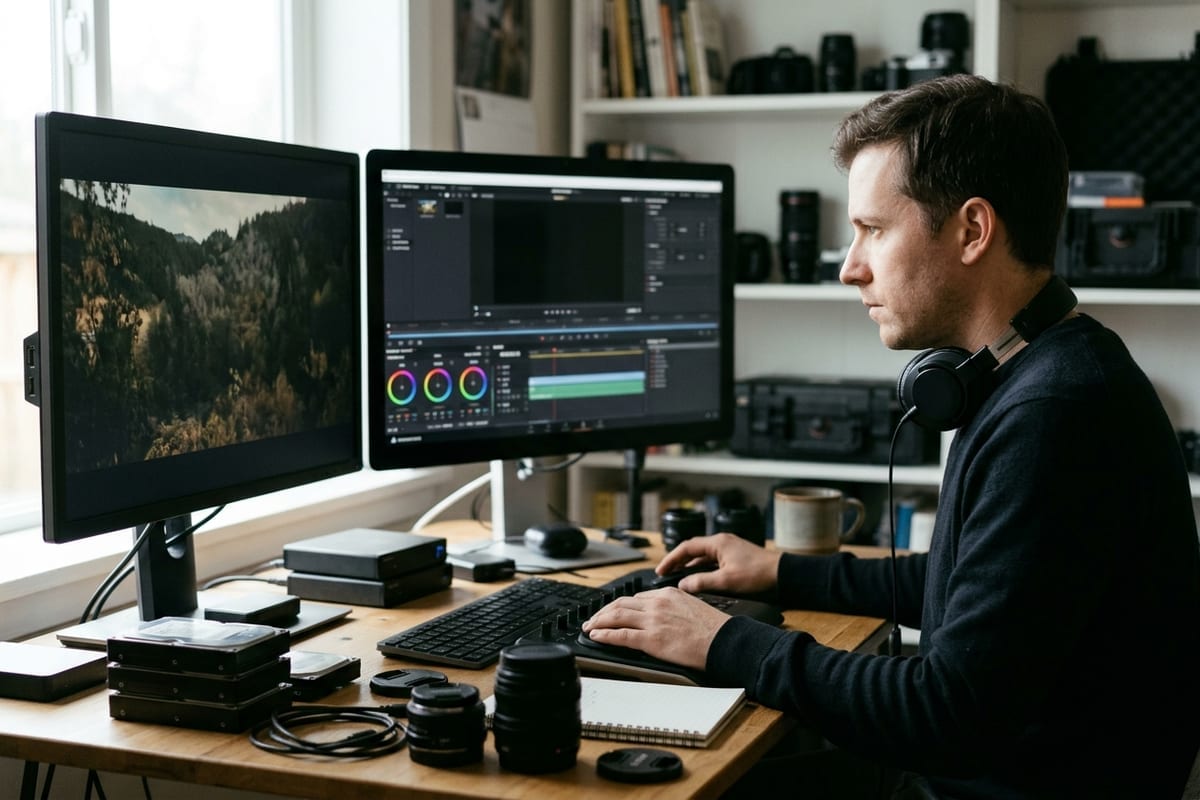
Between 2014 and 2016, Ramos and Zhou released twenty-eight essays that fundamentally altered web culture. The rise of video essayists suddenly accelerated into a mainstream phenomenon. Zhou and Ramos treated their audience with immense respect. They explored the geometry of Buster Keaton’s stunts, the kinetic camera movements of Akira Kurosawa, the editing rhythm of Jackie Chan’s Hong Kong action choreography, and the physical staging of the Coen brothers. They did not review films; they taught viewers how to see.
Zhou’s narration was warm and direct. He spoke not like an intimidating professor, but like a thoughtful friend who had spent ten hours in an editing bay and simply could not wait to show you what he found. The essays moved to the beat of carefully selected jazz and classical scores. Edits snapped exactly on musical downbeats. Every clip was chosen with precision. Millions of casual moviegoers suddenly learned words like “spatial continuity,” “quadrant framing,” and “rhyme cutting.”
A short video worth a few minutes here, from Man Carrying Thing:
The Explosion of Film Literacy Channels
The success of Ramos and Zhou opened the floodgates. Creators realized there was a massive, untapped appetite for serious cultural discussion presented with visual polish. In New York, Evan Puschak launched The Nerdwriter, a channel that applied close reading techniques not just to movies, but to oil paintings, poetry, political speeches, and music production. Puschak’s essay on Donald Trump’s linguistic patterns became an internet sensation, showing how close-reading video techniques could unpack modern rhetoric.
Other brilliant voices arrived in rapid succession. Michael Tucker started Lessons from the Screenplay, breaking down scripts alongside their final filmed executions, using highlighted text and screenplay excerpts to illustrate story structure. Channels like Now You See It and KaptainKristian explored thematic motifs and visual design with stunning motion graphics. Film study was no longer locked away in expensive university seminars. Anyone with an internet connection could understand the mechanics of great art.
The Patreon Lifeline and the Copyright War
This golden age faced an existential threat: the YouTube algorithm and automated copyright bots. Under YouTube’s Content ID system, automated crawlers constantly scanned uploaded videos against studio databases. Studios routinely slapped automated copyright claims or takedown strikes on legitimate fair use analysis, redirecting ad revenues to corporate owners or removing the videos entirely.
Furthermore, YouTube’s advertising payouts were notoriously unpredictable. Creators who spent two months polishing an eight-minute masterpiece could not survive on automated ad revenue alone. The solution arrived through viewer patronage platforms like Patreon. By asking their dedicated viewers to pledge two or five dollars per video, creators liberated themselves from the algorithmic hamster wheel. They did not need to upload clickbait every week. They could take their time, pay licensing fees for music, and focus entirely on editorial quality. Early essayists rarely followed corporate playbooks, but their discipline mirrored the foundational habits of successful employees, turning solitary artistic hobbies into professional, self-sustaining businesses.
2017–2020: The Theatrical Stage and Cultural Autopsies
By late 2017, the landscape was evolving again. Taylor Ramos and Tony Zhou made the difficult decision to retire Every Frame a Painting, noting that the physical and financial toll of producing short, pristine educational essays without corporate sponsorship had run its course. Meanwhile, viewers were changing. The eight-minute explainer was beginning to feel formulaic. The internet had learned the basics of camera movement; now it wanted to talk about politics, identity, industry economics, and moral failures.
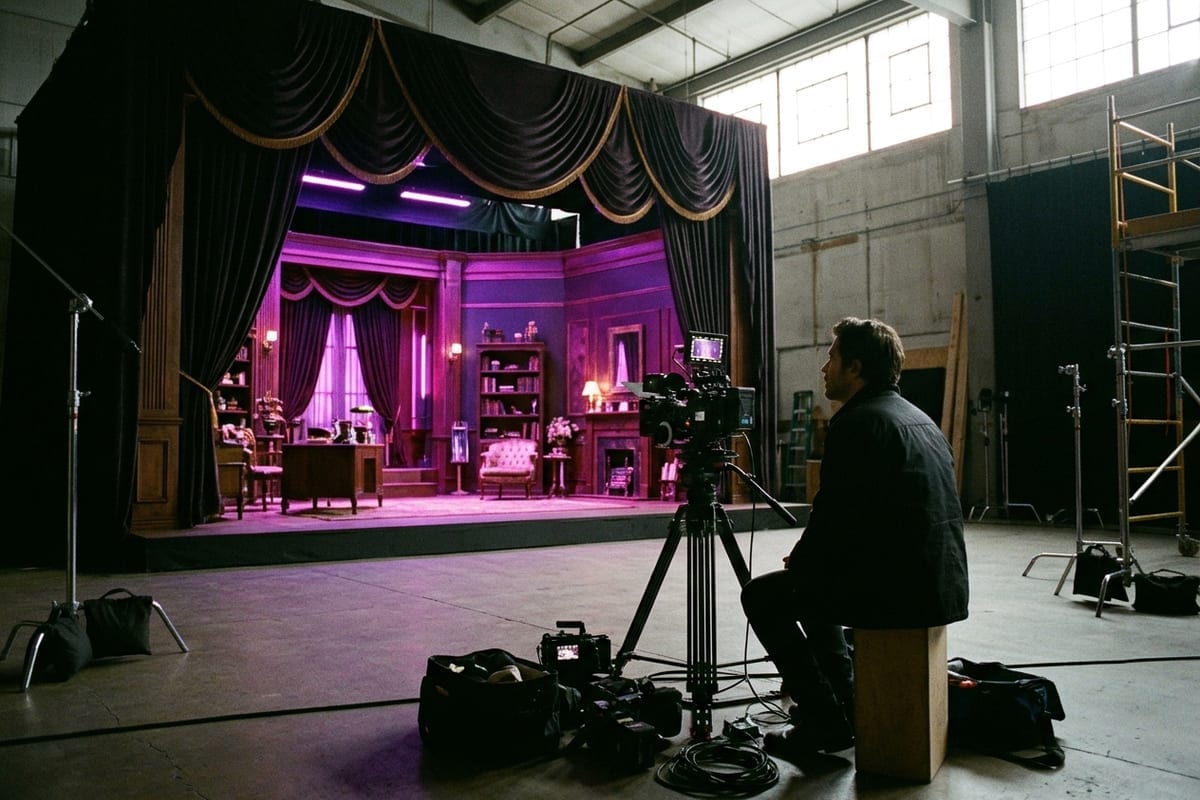
A new wave of creators stepped into the frame, literally. Where earlier essayists hid behind clips and anonymous voiceovers, the new generation stepped in front of the lens. They brought theater, costume design, and elaborate narrative framing into their work. The video essay began borrowing techniques from one-person stage plays and performance art.
Lindsay Ellis and the Big-Picture Post-Mortem
No one illustrated this shift better than Lindsay Ellis. After stepping away from the chaotic sketch-comedy atmosphere of early web platforms, Ellis built a formidable body of work exploring the intersection of corporate capitalism and commercial storytelling. Her three-part documentary series on the troubled production of The Hobbit film trilogy stood as a masterclass in cultural journalism. Ellis did not just talk about bad CGI; she traveled to New Zealand, interviewed union representatives, and examined labor laws to explain why the production unraveled.
Ellis brought academic film theory into conversation with mainstream pop culture. She applied feminist film theory, auteur analysis, and industrial history to blockbuster franchises without ever sounding condescending. She proved that a viewer could love a movie while ruthlessly interrogating its production ethics. Her essays grew in length, regularly stretching to forty, sixty, or ninety minutes. Audiences did not flinch; they settled in with popcorn.
The Theatrical Aesthetics of BreadTube
Around the same time, creators like Natalie Wynn (ContraPoints) and Abigail Thorn (Philosophy Tube) transformed the visual grammar of internet philosophy and media analysis. Wynn abandoned the dry aesthetic of academic lectures, building elaborate sets lit with neon pinks, deep purples, and dramatic chiaroscuro. She donned baroque wigs, satin dresses, and prosthetics, acting out debates between contrasting philosophical viewpoints.
Wynn understood something fundamental about digital culture: aesthetics are arguments. By wrapping dense philosophical inquiries about justice, envy, and visual culture inside camp performance, she held the attention of millions. The runtime of these projects expanded rapidly. An essay was no longer an intermission between web browsing sessions; it was the main event of an evening. Video essayists had stopped imitating short educational segments and started making mid-length feature films.
2021–2026: Feature-Length Ambition and Institutional Honors
As the 2020s unfolded, the medium reached a scale that would have seemed unimaginable to someone ripping DVDs in 2008. The phrase “video essay” began to feel inadequate for projects that demanded months of archival research, original musical scores, motion graphics packages, and runtimes exceeding three hours. These were not video clips. They were independent documentary features distributed directly to global audiences.
In January 2022, Dan Olson of Folding Ideas released Line Goes Up, a blistering two-hour autopsy of speculative digital financial assets and technical culture. The video became an international phenomenon, viewed over thirteen million times and cited by economists, journalists, and everyday web users as the definitive breakdown of modern speculative mania. Olson did not rely on flashy internet tropes. He sat in a chair, spoke with clarity, and used precise graphics to unmask a complex financial structure.
The Four-Hour Investigative Epic
By late 2023, creators pushed runtimes to their absolute limits. British creator Harry Brewis (Hbomberguy) published Plagiarism and You(Tube), a nearly four-hour investigative epic examining intellectual theft among internet creators. The video was structured like a gripping legal thriller, cross-referencing audio waveforms, archival forum posts, and published books to uncover systemic plagiarism. Viewers did not treat the four-hour runtime as a barrier; they treated it like an event, gathering on social media to dissect every revelation.
Jenny Nicholson adopted a similar long-form narrative rigor. In May 2024, Nicholson released a four-hour deep dive into the disastrous corporate mismanagement of an immersive theme-park hotel experience. Combining exhaustive personal video documentation, spreadsheet budgeting, and wry, deadpan performance, Nicholson’s video was hailed by critics as one of the finest consumer investigative reports of the decade. These creators proved that when analysis is thorough, humorous, and humane, an audience will gladly watch a four-hour piece in a single sitting.
The Museum, the Festival, and the Criterion Channel
Traditional institutions could no longer pretend the video essay was an amateur internet distraction. In the early 2020s, prestigious cinema organizations began embracing the form as a vital branch of film culture. The British Film Institute’s monthly magazine, Sight & Sound, established an annual international critics’ poll dedicated exclusively to honoring the best video essays of the year. Film scholars and festival programmers sat alongside web essayists on judging panels.
Meanwhile, physical media distributors recognized that video essayists were the natural heirs to the beloved DVD audio commentary. The Criterion Collection began commissioning creators like Taylor Ramos and Tony Zhou to produce original video essays for physical 4K and Blu-ray releases. In 2021, Netflix released Voir, a visual essay documentary series executive produced by David Fincher and featuring contributions from prominent internet critics. The wall separating Hollywood, academia, and the desktop creator had finally crumbled.
Streaming alternatives like Nebula also emerged, allowing essayists to build subscription businesses outside the volatile whims of automated recommendation engines. Creators could invest in real camera packages, hire professional sound designers, and conduct field reporting. Managing these massive personal video archives and research libraries became a major logistical challenge. Much like the careful work required when helping an aging parent downsize without the power struggles, creators found that sorting through physical collections, digitizing rare tapes, and letting go of unnecessary archival clutter was necessary to keep their working studios functional.
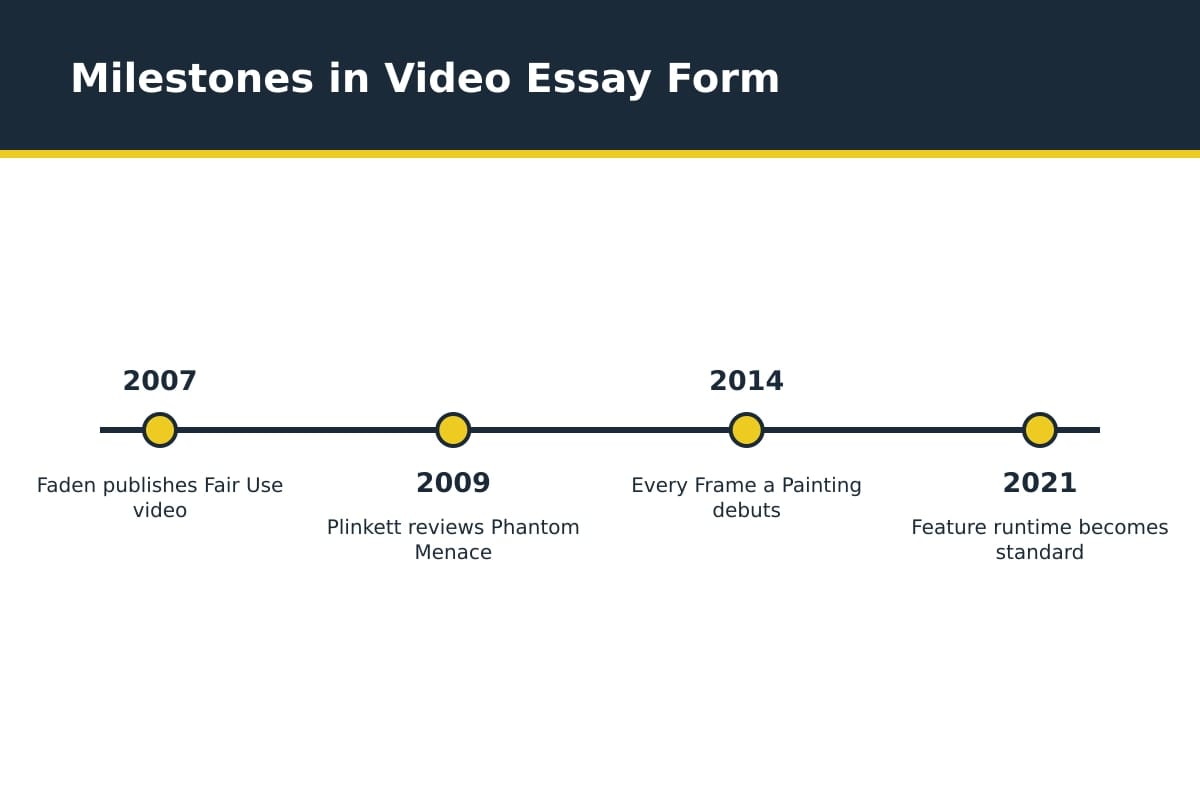
Milestones in the Evolution of Video Essays
To see how rapidly the form matured, consider this chronological record of key breakthroughs over the past three decades:
| Year | Milestone Event | Significance to the Medium |
|---|---|---|
| 1998 | Jean-Luc Godard completes Histoire(s) du cinéma | Establishes the cinematic precedent for thinking through juxtaposed moving images. |
| 1999 | DeCSS software created | Allows consumer computers to extract digital video files directly from commercial DVDs. |
| 2007 | Eric Faden releases A Fair(y) Use Tale | Demonstrates how educational video essays qualify under fair use copyright doctrine. |
| 2009 | RedLetterMedia uploads the Plinkett Phantom Menace review | Proves massive internet audience appetite for long-form narrative deconstruction. |
| 2011 | Kevin B. Lee pioneers “desktop documentary” at Fandor | Brings academic rigor and screen-capture aesthetics into serious film criticism. |
| 2014 | Every Frame a Painting launches on YouTube | Redefines the craft standard, teaching editing, rhythm, and framing to millions. |
| 2017 | Lindsay Ellis begins The Hobbit documentary series | Expands web video essays into high-budget industrial reporting and corporate critiques. |
| 2021 | David Fincher produces Voir for Netflix | Institutional streaming services formally commission video essayists for mainstream release. |
| 2023 | Hbomberguy releases Plagiarism and You(Tube) | The four-hour investigative essay becomes a cultural blockbuster with tens of millions of views. |
| 2024 | Jenny Nicholson publishes the Galactic Starcruiser critique | Demonstrates that exhaustive consumer cultural history rivals major investigative journalism. |
More on this:Helping an Aging Parent Downsize Without the Power Struggles
So, What Now? The Future of Screen Literacy
We live in an age drowning in moving images. Short-form algorithmic feeds blast twelve-second snippets into our pockets at all hours of the day. Synthetic media, automated video generators, and digital hallucinations are flooding the web with slick, hollow content. It has never been easier to produce an image, and it has never been harder to figure out what an image means.
[[COMIC: An animated viewer surrounded by open browser tabs holding a giant tub of popcorn | comic | watching online video]]
That is precisely why the rise of video essayists matters more now than ever before. In a media ecosystem designed to shorten our attention spans, the video essay demands that we slow down. It invites us to look at the edges of the frame. It asks us to notice where the lighting source originates, why a cut occurred half a second before we expected it, and whose voice was left off the soundtrack. The essayist does not want us to turn our brains off; they want us to wake up to the machinery of modern mythmaking.
The medium will continue to shift. Some creators are moving into festival circuits, screening their works in physical cinemas alongside narrative features. Others are experimenting with interactive media and live desktop performances. Yet no matter how complex the camera rigs or research teams become, the heart of the form remains unchanged. It is still an act of profound, generous communication.
Think back to that snowy Milwaukee evening in 2009. A lone creator sat in a dimly lit room, holding a plastic microphone, cutting up low-resolution clips on an old operating system simply because he loved the craft of storytelling too much to let a bad movie slide by unchallenged. What began as a stubborn, grainy hobby blossomed into a global classroom. The rise of video essayists did not just teach us how movies are made. It gave ordinary audiences the tools to read the visual language of the modern world.