
A widespread assumption persists across campuses and kitchen tables: if a textbook or course guide is free online, it must be either an illicit scan or poor in quality. People assume that real academic scholarship always arrives wrapped in plastic film with an expensive price tag attached. That belief is false. It mistakes commercial exclusivity for intellectual rigor. High-quality academic knowledge can be openly shared without cutting corners, shortchanging authors, or breaking copyright law.
This is where open educational resources enter the picture. Known widely as OER, these materials include complete textbooks, lecture slides, lab manuals, and full degree curricula that are published under licenses allowing anyone in the world to read, download, share, and alter them without paying a cent. Understanding open educational resources gives students, educators, and lifelong learners a direct path toward debt-free, high-quality study. Education ought to be an open door. It should never be an eviction notice delivered through a bookstore receipt.
Textbook costs act as an invisible gatekeeper in modern education
Commercial textbook publishing has spent decades functioning as a captive market. When an instructor assigns a specific volume, a student cannot simply walk across the street and choose a cheaper brand. The customer does not choose the product, and the person choosing the product does not pay for it. That broken economic model has caused prices to climb far faster than ordinary wages.
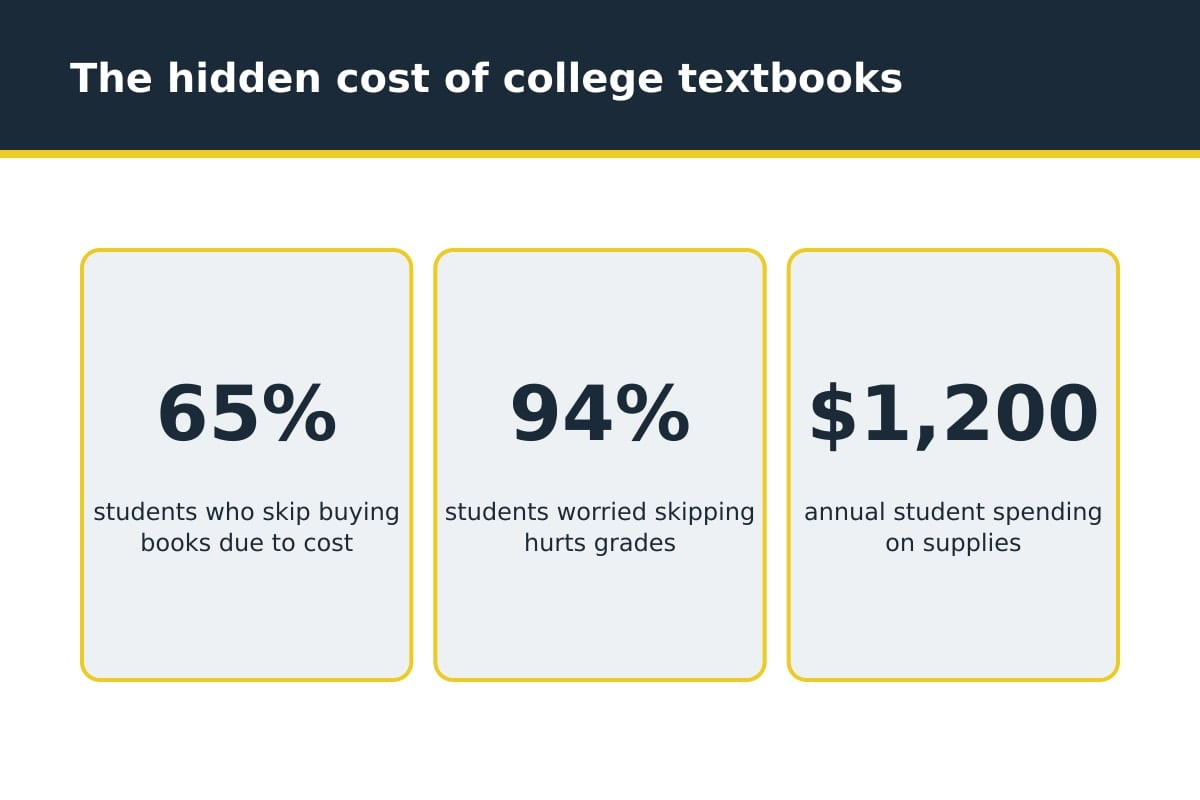
According to the College Board and data published by the Education Data Initiative, the average full-time undergraduate student in the United States budgets between $1,200 and $1,300 every year for books and supplies alone. For a student attending a local community college, course materials can represent nearly 40 percent of total tuition costs. That financial wall changes how people learn.
When books cost hundreds of dollars, students are forced to make painful calculations. In national research conducted by the Student Public Interest Research Groups (Student PIRGs), 65 percent of surveyed students reported that they skipped buying an assigned textbook because of its price. Among those who went without their books, 94 percent recognized that their grades would suffer as a consequence. Learning cannot happen in earnest when someone enters a classroom lacking the basic tools of study.
In recent years, the commercial market evolved in ways that closed access even further. Publishers shifted away from heavy paperbacks toward single-use digital access codes. In their 2025 and 2026 reporting, Student PIRGs found that roughly three out of four surveyed college students had to purchase an access code to complete graded homework. An access code cannot be bought used from a friend. It cannot be checked out from a library reserve shelf. Once the semester ends, the code expires, and the student loses access to their own reading notes.
This model commodifies what ought to be a lasting intellectual foundation. When course access turns into a temporary lease, education stops feeling like an enduring pursuit and starts feeling like an automated tollbooth. Open courseware provides an alternative built on generosity, permanence, and communal trust.
What open educational resources actually mean for everyday learning
The term open educational resources was coined globally in 2002 during a forum convened by the United Nations Educational, Scientific and Cultural Organization. The UNESCO Recommendation on Open Educational Resources defines them as learning, teaching, and research materials in any format that reside in the public domain or have been released under an open license that permits no-cost access, reuse, re-purposing, adaptation, and redistribution by others.
Notice the distinction between free and open. Free simply means you do not pay money at the point of access. A copyrighted PDF sitting on a corporate website might be gratis to view, but you cannot legally copy it for your classmates, translate it into another language, or update an outdated chapter. Open means freedom in the active sense. It gives you legal permission to participate in the text itself.
Education researcher David Wiley articulated this distinction through what the open community calls the 5R permissions. These five actions define what makes an educational asset genuinely open:
Retain
The right to make, own, and control copies of the content. You can download the textbook to your hard drive, keep it on a flash drive, and hold it forever. It will never vanish when a subscription runs out.
Reuse
The right to use the content in its original form in a classroom, a study circle, a personal notebook, or a community workshop without asking for special permission.
Revise
The right to adapt, adjust, modify, or translate the material. An educator can rewrite confusing explanations, correct typos, or change terminology to reflect local reality.
Remix
The right to combine the original material with other open content to create something fresh. An instructor might merge three chapters of an open biology manual with two chapters of an open chemistry guide to build a customized biochemistry syllabus.
Redistribute
The right to share copies of your original work or your revised versions with anyone else. You can print physical copies for students or post the altered file on a neighborhood forum.
Think of it through the analogy of an old family recipe card. When someone hands you a handwritten soup recipe, you do not just get to eat the soup once. You keep the index card in your kitchen box. If your grandmother prefers more garlic or you cannot eat dairy, you alter the recipe to suit your table. When your neighbor asks how you made it, you write out a clean copy and give it to them freely. Commercial publishing, by comparison, delivers a frozen dinner in a box that locks itself shut if you fail to renew your subscription every three months.
How Creative Commons licenses grant you legal permission
Traditional copyright law operates on an “all rights reserved” principle. The moment an author writes a book, the law grants them exclusive control over reproduction and distribution. Anyone wishing to share or adapt that book must request written clearance or rely on narrow fair-use defenses. This system was designed to protect commercial profits, but it frequently stifles the free exchange of classroom knowledge.
In 2001, a nonprofit organization called Creative Commons established a legal framework to bridge that gap. Rather than demanding all rights reserved, Creative Commons licenses let creators say “some rights reserved.” Authors retain their copyright while giving the public clear, standardized permissions in advance.
These licenses are constructed from four simple modular terms:
BY (Attribution)
You may share and adapt the material as long as you credit the original creator.
SA (ShareAlike)
If you remix or alter the work, you must release your new version under the exact same license. This keeps the material permanently open for future generations.
NC (NonCommercial)
You can share and adapt the text, but nobody is allowed to sell it for commercial gain.
ND (NoDerivatives)
You can copy and distribute the work, but you cannot change, edit, or remix it.
These four elements combine into six standardized licenses. The most permissive is CC BY, which requires only attribution. The most restrictive is CC BY-NC-ND, which requires attribution, forbids commercial use, and blocks any editing.
Here is where newcomers often stumble. Not every Creative Commons license qualifies as an open educational resource. If a license contains the NoDerivatives (ND) condition, it prevents educators and learners from revising or remixing the content. It breaks two of the 5R permissions. While a CC BY-NC-ND book is free to read, it is not truly open. When searching for materials you can adapt for your classes, look for CC BY, CC BY-SA, CC BY-NC, or CC BY-NC-SA.
There is also the Public Domain, often indicated by the CC0 mark. Works in the public domain have no copyright restrictions attached at all. You can use them, sell them, rewrite them, or print them without asking anyone or even providing an author citation, though academic ethics always encourage acknowledging your sources.
Where to find verified open course materials across four countries
Finding legitimate open materials does not require scouring obscure web forums. Over the past twenty years, university consortia, national governments, and philanthropic foundations have built rigorous, peer-reviewed digital libraries. These platforms catalog tens of thousands of books across science, humanities, trade vocations, and professional degrees.
Because higher education systems vary across borders, examining how four distinct countries organize their open repositories provides a practical roadmap for finding zero-cost materials.
United States: institutional giants and community collections
The United States houses some of the most comprehensive open textbook initiatives in existence. The movement gained major traction here because American students bear unusually heavy out-of-pocket expenses for tuition and course materials.
The most visible American project is OpenStax, based at Rice University. OpenStax publishes peer-reviewed, professionally edited textbooks for the highest-enrollment introductory college courses, including general chemistry, sociology, calculus, macroeconomics, and American history. Each textbook is authored by disciplinary experts, reviewed by dozens of faculty members, and paired with free online slides and practice question banks. Students can read them online for free, download PDFs, or order a low-cost print copy through campus bookstores.
Another central American hub is the Open Textbook Library, managed by the Open Education Network at the University of Minnesota. Rather than publishing its own books, this repository acts as a curated clearinghouse. To be included in the library, a book must be openly licensed, complete, and used at multiple higher education institutions. Crucially, the platform hosts thousands of written peer reviews from university professors who evaluate each volume on clarity, accuracy, cultural relevance, and interface design.
For modular science learning, LibreTexts, developed out of the University of California, Davis, offers massive interconnected “libraries” across STEM disciplines. Educators can extract individual pages from different open texts to construct a bespoke digital course pack.
Canada: provincial leadership and indigenous integration
Canadian post-secondary institutions have led the world in provincial coordination. Rather than leaving each university to work in isolation, provincial ministries established shared public agencies to curate and adapt open learning materials.
In British Columbia, BCcampus OpenEd serves as the gold standard. Founded with funding from the Ministry of Post-Secondary Education and Future Skills, BCcampus catalogs hundreds of open textbooks tailored specifically to Canadian curricula. A notable strength of the BCcampus catalog is its focus on trades training—such as plumbing, automotive mechanics, and electrical wiring—alongside traditional academic degrees. Furthermore, Canadian open educators lead deliberate efforts to incorporate Indigenous knowledge systems, providing localized adaptations that reflect First Nations perspectives.
In Ontario, eCampusOntario operates the Open Library. This bilingual repository houses resources in English and French, covering college and university subjects. Learners can filter materials by discipline, license, or available file formats, including editable Pressbooks files that make classroom customization straightforward.
United Kingdom: open universities and national teaching repositories
The United Kingdom approaches open education through a distinct historical lens. The UK was an early pioneer of distance education through The Open University, founded in 1969 to make higher education available to anyone regardless of prior qualifications.
Today, The Open University runs OpenLearn, a massive public portal offering thousands of hours of free study materials, structured courseware, and interactive units. While some OpenLearn content carries custom licenses, a substantial portion is released under Creative Commons agreements. These courses span subjects from introductory digital literacy to advanced forensic psychology.
Additionally, British academic librarians collaborate through Jisc (formerly the Joint Information Systems Committee) and the National Teaching Repository. These platforms allow British scholars to share openly licensed slide decks, marking rubrics, assessment guides, and seminar plans. The UK tradition leans heavily into courseware and learning objects—meaning modular classroom exercises and digital simulations that complement standard readings.
Australia: collaborative university collectives and regional access
Higher education in Australia faces unique geographic realities. With regional universities serving students spread across vast rural territories and coastal hubs, open digital resources solve both financial and physical distribution hurdles.
The Council of Australian University Librarians (CAUL) created the Open Educational Resources Collective. This collaborative network brings together dozens of universities across Australia and New Zealand. Member institutions share a unified publishing platform to author, adapt, and peer-review textbooks built around Australian legal standards, healthcare guidelines, and environmental sciences.
Regional institutions have embraced this approach with particular energy. The University of Southern Queensland (UniSQ) and Western Sydney University publish dedicated open catalogs. For example, their open law texts incorporate Australian Commonwealth statutes and Indigenous land title law, ensuring that students study materials written for their domestic legal system rather than imported American casebooks.
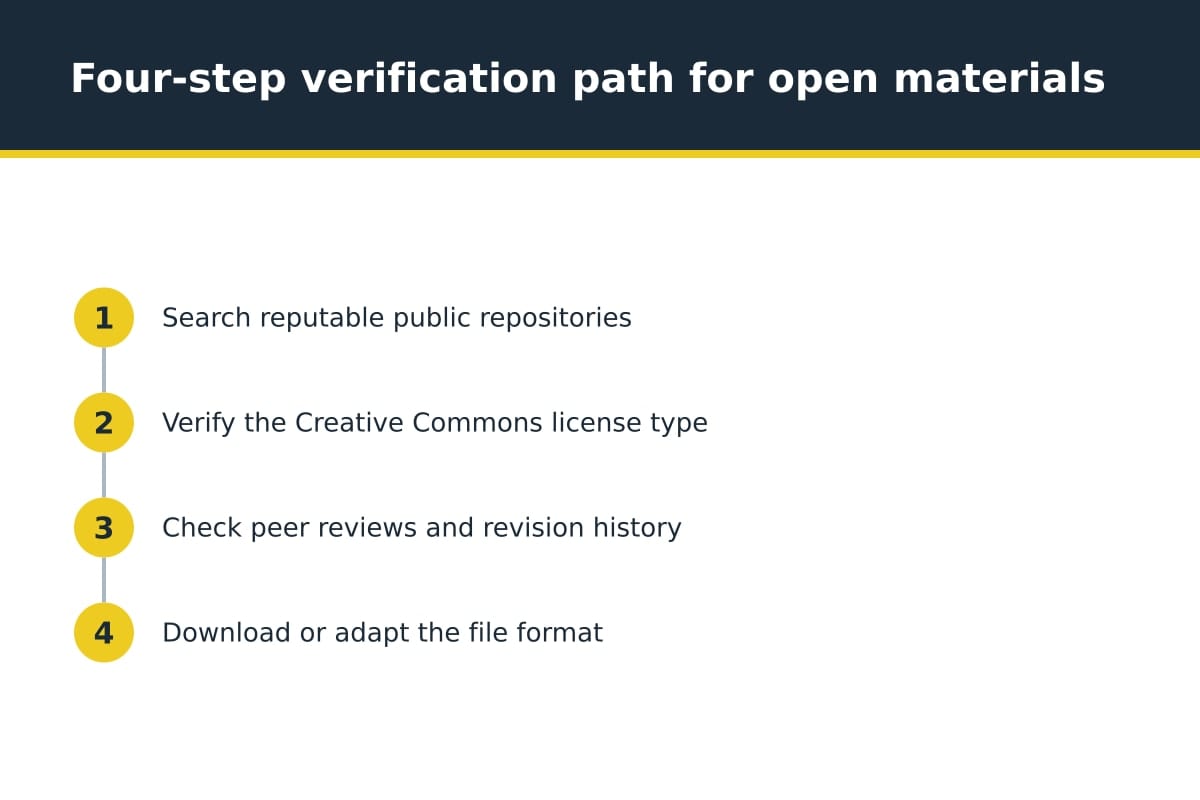
How to judge whether an open textbook is trustworthy
Newcomers to open resources often wonder how to verify the academic reliability of a book that cost them nothing. In a commercial market, people rely on publisher prestige as a mental shortcut for quality. When evaluating an open text, you look directly at evidence of scholarly craft.
Librarians and faculty evaluate open materials using several objective criteria:
Author credentials and institutional backing
Check the title page and front matter. Was the book written by tenured faculty or experienced practitioners in that subject? Did an institutional initiative, like Rice University or the British Columbia government, sponsor the publication?
Documented peer review
Trustworthy open repositories publish peer-review statements. Platforms like the Open Textbook Library publish extensive faculty reviews evaluating whether the concepts are clear, accurate, and up to date.
Accessibility design
A well-made digital text follows modern web accessibility standards (such as WCAG compliance). It should offer screen-reader compatible formatting, descriptive alt text for diagrams, and readable typographic contrast.
License transparency
A legitimate open educational resource displays its exact Creative Commons license clearly on the landing page and inside the front matter. Ambiguous copyright language is a red flag.
Version history
Digital texts must stay accurate. Repositories using platforms like Pressbooks or LibreTexts often maintain a public changelog showing when errata were corrected or when content was updated.
Many adult learners who return to school juggle the dual pressure of classroom reading lists and family responsibilities. If you have young children at home while earning a degree, keeping everyday expenses manageable is just as necessary as finding free textbooks. Knowing How to Vet a Daycare: The Ultimate Safety & Staff Checklist gives you peace of mind so you can focus on your studies. In the same vein, keeping a clear Daycare Safety Checklist: Red Flags Parents Need to Spot nearby helps student-parents protect their family budget and their child’s safety while spending their evenings completing coursework.
Adapting and remixing open resources for your own community
Reading a zero-cost textbook saves money. Adapting that textbook transforms the learning experience itself. This is where the open model diverges completely from commercial publishing.
When an instructor adopts a traditional textbook, they often assign chapters out of order, skip irrelevant sections, and apologize to students for awkward phrasing or missing context. When an instructor adopts an open textbook, they take active ownership of the material. If Chapter 4 uses examples from 1995, the teacher updates them to reflect current events. If the case studies lack racial or geographic diversity, the instructor writes new ones that speak directly to the lived experiences in the room.
Students can participate in this process too. In open pedagogy courses, students do not write disposable essays that end up in the recycling bin at the end of the term. Instead, they write review questions, create explanatory glossaries, or draft case studies that are edited and merged into next year’s edition of the open textbook. Learning becomes an act of collective authorship.
Adapting an open work relies on open editing platforms. Software like Pressbooks allows users to clone an existing open textbook, modify the text in a browser interface, and export the finished volume as a mobile-friendly EPUB, a print-ready PDF, or interactive web pages. Because the underlying licenses permit revision, these adaptations remain entirely legal.
Seeing it helps. Here’s a clear walkthrough from University of Houston Libraries:
A quick glossary of open education terms
When entering the world of open learning, you will encounter legal and technical shorthand. This reference table clarifies the core concepts you will see across course syllabi and university catalogs.
| Term | Plain-English meaning |
|---|---|
OER | Open educational resources; free teaching and learning materials that carry open legal permissions to share and edit. |
Creative Commons | A legal framework offering standardized public licenses that allow creators to grant permissions in advance. |
Public Domain | Creative work with expired or waived copyright; completely free for anyone to use without restriction. |
5R Permissions | The five core rights defining true openness: Retain, Reuse, Revise, Remix, and Redistribute. |
Open Pedagogy | Teaching practices that involve students in creating, adapting, or improving open knowledge commons. |
Pressbooks | An open-source digital book production tool widely used by universities to author and publish open courseware. |
Zero Textbook Cost (ZTC) | A degree pathway or course designation where students incur zero out-of-pocket costs for instructional materials. |
Questions people often ask about open learning
Are open educational resources really completely free to use?
Yes, open educational resources are entirely free to access, download, and retain in digital formats. You do not need to enter credit card details or buy an expiring subscription. If you prefer holding a physical paper book, you may choose to pay a small printing cost through your campus print shop or an online print-on-demand service.
How do open textbooks compare to commercial textbooks in academic quality?
Independent research shows that students using open textbooks perform just as well as, or better than, those using traditional commercial texts. Major repositories like OpenStax and the Open Textbook Library use rigorous peer-review procedures, hiring subject-matter professors to write and edit the content. Because the files are open, community members catch and correct factual errors much faster than commercial print cycles permit.
Can an instructor get into legal trouble for adapting an open textbook?
Instructors are completely protected by law as long as they respect the terms of the Creative Commons license attached to the work. This simply requires citing the original author and avoiding the creation of adaptations if the book carries a NoDerivatives (ND) license. When an open resource carries a CC BY or CC BY-SA license, modification and redistribution are explicitly permitted rights.
Why would an author give away their academic book for free?
Many academic scholars write textbooks to advance knowledge, support their students, and expand their pedagogical reach rather than to earn modest royalty checks. Grants from universities, philanthropic foundations, and government programs frequently fund the authoring and peer review of open materials. Authors retain credit for their scholarship while ensuring their work reaches students across the globe without financial barriers.
One last thing
Knowledge is not property to be locked in a vault. It is a shared heritage that grows richer the more freely it travels from mind to mind. When commercial gatekeepers attach steep price tags to introductory education, they communicate to students that deep learning belongs only to those who can afford the entrance fee. Embracing open educational resources dismantles that quiet exclusion.
You do not need an administrator’s permission to begin. Take one practical step today: open your browser, visit the Open Textbook Library or the BCcampus catalog, type in the subject of a class you are currently taking or teaching, and download a chapter. See how the prose reads. Look at the license on the copyright page. Once you witness high-level scholarship freely available for anyone to read and keep, your view of academic learning will never be the same.