
Key Takeaways
- Grade guidance gives operators a live reference for target depth, slope, and elevation.
- 2D systems are well-suited to repetitive excavation work, while 3D systems support complex digital designs.
- Better first-pass accuracy can limit over-excavation, corrective filling, and repeated grade checks.
- Guidance can support safer workflows, but it does not replace competent supervision or excavation safety procedures.
- The best system is the one that fits the contractor’s usual jobs, crew skills, and setup process.
Why Excavation Accuracy Matters More Than Ever
Excavation mistakes can become expensive quickly. Digging below design grade may require additional backfill, compaction, material handling, and time. Leaving a trench too shallow or cutting an uneven foundation area can delay the crews responsible for pipe, drainage, concrete, or site finishing. Since multiple trades often rely on the same elevations, a small error at the excavation stage can create avoidable corrections later.
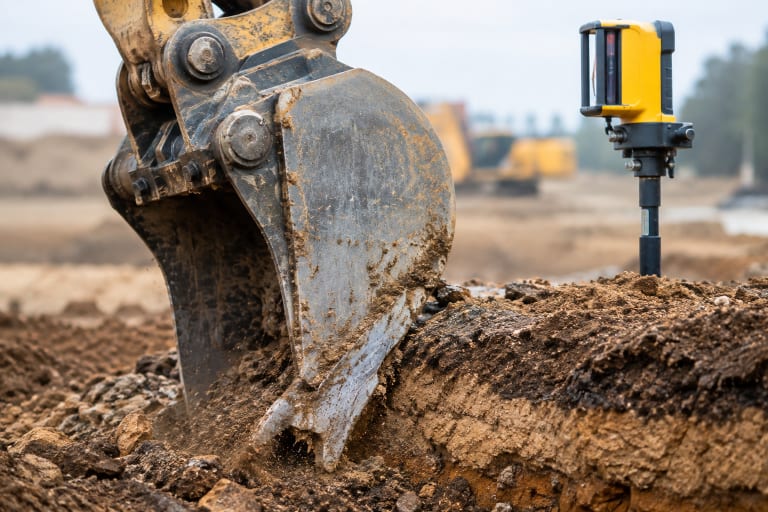
For contractors trying to keep small crews moving, excavator laser grade control is an example of equipment designed to provide in-cab depth and slope feedback. The goal is not to remove operator judgment. It is to give the operator a clearer, faster reference while digging, so the machine can work closer to the planned grade from the start.
What Smart Excavator Guidance Actually Does
Smart excavator guidance combines machine-mounted sensors, a display, and one or more job-site references to show the bucket’s position relative to a target. Depending on the setup, that reference may be a rotating laser, a known benchmark, GNSS positioning, or a digital terrain model. The display can help the operator see depth, slope, elevation, and bucket position without relying solely on repeated manual checks.
These systems are guidance tools, not substitutes for an attentive operator. The operator still controls the machine, watches the swing area, confirms the task, and responds to changing ground conditions. Survey control, layout, and independent quality checks also remain important, especially when the work affects utilities, drainage, structures, or public infrastructure.
2D and 3D Systems: Which One Fits the Job?
The choice should begin with the kind of work performed most often, not with the most advanced feature list.
- 2D guidance: Often appropriate for straight trenches, footings, basements, and consistent slopes where the operator needs a reliable depth or elevation reference.
- Laser-based guidance: Useful when a rotating laser can establish a stable height reference over the active work area.
- 3D guidance: Better suited to irregular contours, road corridors, larger grading plans, and jobs built from digital design data.
- GNSS-based guidance: Can be valuable on broad sites where the machine needs to work from a coordinate-based model rather than a single local elevation reference.
Federal highway agencies have encouraged the use of 3D-engineered models in highway construction, while also recognizing that implementation requires model quality, survey processes, training, and quality assurance. For many smaller contractors, a straightforward system that crews can set up correctly and use consistently may deliver more practical value than a complex workflow that is rarely needed.
Where Grade Guidance Can Reduce Rework
Utility Trenches and Drainage Runs
Trenches for water, sewer, stormwater, and other services often need consistent depth and a planned fall. Live guidance can help an operator maintain a target more steadily along the run, reducing the number of times the crew stops to correct high spots, low spots, or sections excavated too deeply.
Foundation and Footing Excavation
For building pads, footings, and basement cuts, the objective is usually a more even excavation that leaves less material to remove or replace. Guidance can help the operator approach finish depth carefully, particularly when working across a large area where visual judgment alone may be less reliable.
Finish Grading and Small-Site Work
Pads, ramps, shoulders, septic work, and drainage swales can all benefit from a clear grade reference. On these jobs, the value may come from reducing interruptions rather than from one dramatic time savings. Fewer pauses for measuring and fewer corrective passes can keep a compact crew focused on production.
How Better Guidance Can Support Safer Work
Guidance does not make an excavation safe by itself. Trench protection, utility locating, access and egress, inspections, exclusion zones, and communication still control the most serious risks. OSHA notes that cave-ins are the greatest threat to workers in trenches and emphasizes protective approaches such as sloping, shoring, or shielding trench walls.
Used correctly, in-cab grade information can support a safer workflow by reducing unnecessary reasons for workers to approach an active machine or enter an excavation merely to check a measurement. The machine operator should still maintain awareness of spotters, nearby workers, overhead hazards, underground services, and changing site conditions. A display is useful information, not permission to bypass the site safety plan.
Labor and Productivity Benefits
Grade guidance can help crews use available labor more deliberately. When an operator can see relevant depth or slope information from the cab, a helper or supervisor may spend less time performing routine checks and more time on layout, traffic control, material coordination, or other productive work. Results will vary with soil conditions, design complexity, operator experience, machine setup, and the accuracy of the reference system.
- Fewer pauses for routine manual measurements.
- Less over-digging and less corrective backfill.
- More consistent work across shifts or operators.
- Less idle time while waiting for grade confirmation.
- Better visibility into whether excavation is approaching the final grade.
What to Check Before Choosing a System
Before investing, contractors should identify the jobs that cause the most repeated checking or rework. Then evaluate whether a basic depth-and-slope setup solves that problem or whether the work truly requires a digital 3D model.
- What work will the machine perform most often?
- Will the system be used on one machine or moved among several machines?
- How will operators establish and verify the reference point?
- Is the display readable in bright light, rain, dust, and normal cab vibration?
- What training is provided for setup, normal operation, and equipment failure?
- Can the team verify design files and machine calibration before production begins?
Common Setup and Training Mistakes
Poor results often begin before the first bucket enters the ground. Incorrect sensor placement, an unverified laser reference, outdated digital design files, changes to attachments, or unclear benchmarks can lead to inaccurate guidance. Operators also need time to understand what the display is showing and when an independent check is required.
- Start with a repeatable project type, such as a trench or footing excavation.
- Verify the design, benchmark, attachment setup, and reference before digging.
- Train operators on both normal use and loss-of-reference conditions.
- Confirm results with independent checks during the initial rollout.
- Record lessons learned before expanding to additional machines or job types.
A Simple Return-on-Investment Check
Measure real job outcomes instead of relying on broad promises. Track labor hours spent checking grade, excess material removed, imported backfill, corrective excavation passes, and downtime while waiting for measurements. Comparing several similar jobs can show whether guidance is reducing avoidable work. Often, the value comes from many small improvements repeated throughout a season.
Conclusion
Smart excavator guidance is most useful when it addresses a clear field problem. Matched to the right work, it can help operators maintain grade more consistently, reduce rework, and limit unnecessary interruptions. Strong results still depend on verified control points, capable operators, independent checks, and a jobsite safety plan that oversees every excavation.