
“Why do I feel so dirty inside, even though I was only doing what my boss, my institution, or my family demanded of me?” That is the quiet, agonizing question sitting beneath your exhaustion. When you carry a persistent ache that weekend rest and vacation days cannot touch, you are rarely just tired; you are ethically wounded. Here is moral injury explained in plain terms, stripping away clinical jargon to show how everyday institutional pressures crack our sense of self, why organizations push decent people into ethical collisions, and how human beings find their way back to wholeness.
What is moral injury explained in simple terms?
Moral injury is the profound psychological, social, and spiritual suffering that occurs when you participate in, witness, or fail to prevent actions that transgress your core ethical convictions.
Think of it not as a mental illness, but as an ontological bruise. When you stub your toe on a social faux pas, you feel embarrassment. When you accidentally break a minor office protocol, you feel momentary irritation. But moral injury strikes at your understanding of reality. It happens when the tacit contract between your inner values and the external world is violently torn up.
You may have lived for decades believing that if you worked hard, told the truth, and treated others with decency, your community or employer would do the same. Then comes the collision. You are ordered to falsify a regulatory filing. You are pressured to deny medical coverage to an impoverished patient to preserve departmental profit margins. Or perhaps you stand by silently while an innocent colleague is made a scapegoat, knowing that speaking up would cost you your livelihood. In that single moment, your internal compass spins wildly. The world is suddenly revealed as cynical, and you find yourself cast as an unwilling accomplice.
The term itself emerged from clinical work with combat veterans. In his foundational writing for the Department of Veterans Affairs, psychiatrist Jonathan Shay defined moral injury as having three distinct elements: “a betrayal of what’s right, by someone who holds legitimate authority, in a high-stakes situation.” Subsequent research led by clinical psychologist Brett Litz broadened the framework. Today, we understand that whether you pull a trigger in an armed conflict or rubber-stamp an eviction notice from an air-conditioned office cubicle, the tearing of the conscience produces the exact same internal fracture.
How does moral injury differ from burnout and PTSD?
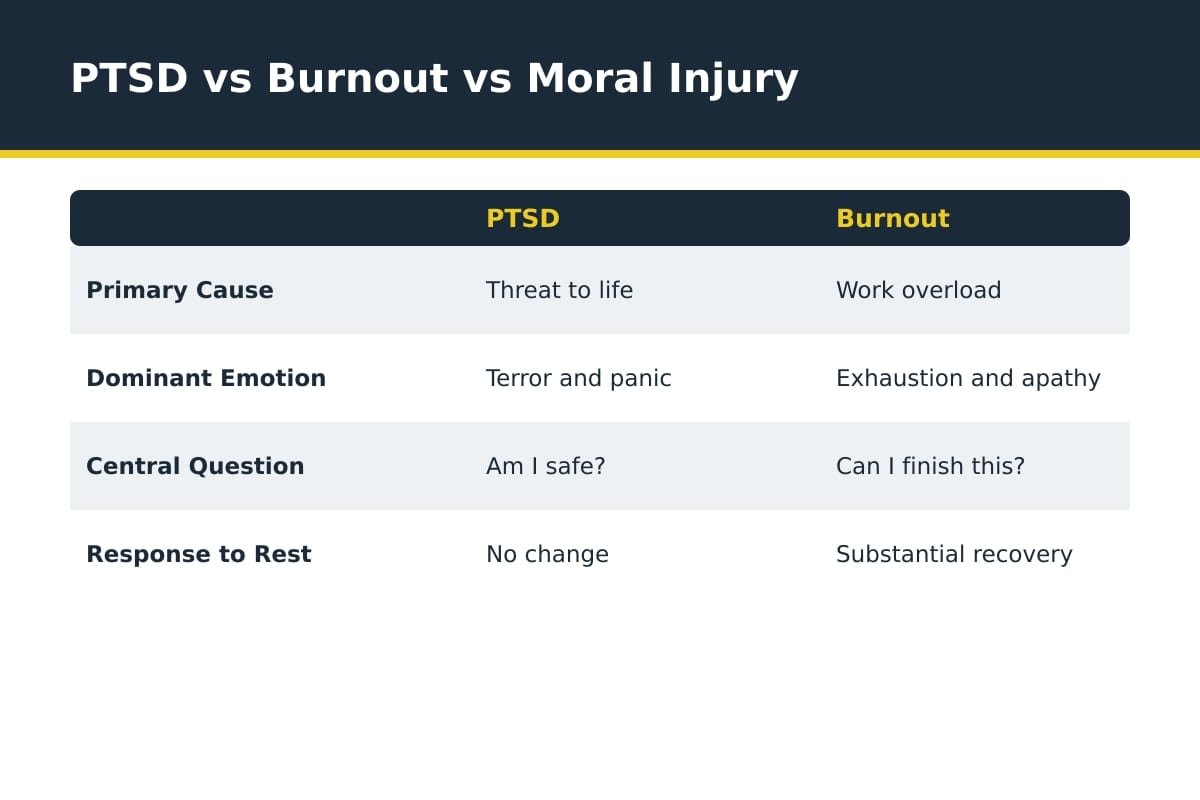
While burnout depletes your physical stamina and post-traumatic stress disorder shatters your sense of physical safety, moral injury shatters your belief in your own goodness or the goodness of others.
The distinction matters immensely because applying the wrong remedy to an ethical wound only deepens the insult. Consider burnout. Burnout is fundamentally an energy crisis. You have given more labor, hours, and attention than your biology can sustain. If an exhausted software developer or teacher takes a three-month sabbatical to sleep, hike mountains, and eat nourishing meals, their nervous system gradually resets. Burnout responds to rest.
Moral injury does not respond to a holiday. Send a morally injured person to a sunlit beach for a month, and they will simply sit beneath the palm trees replaying the moment they compromised themselves. The quiet horror follows them into the hotel room. It is not an issue of depleted batteries; it is an issue of spoiled meaning.
Post-traumatic stress disorder, thoroughly documented by the National Center for PTSD, operates through fear circuitry. In PTSD, the brain’s survival mechanisms remain trapped in life-or-death vigilance. A sudden loud noise or a crowded room triggers adrenaline, panic, and an overwhelming drive to escape. The primary question haunting PTSD is: Am I safe?
Moral injury asks a radically different question: Am I still decent? Its currency is not fear, but guilt, shame, moral disgust, and profound grief. You do not check the room for hidden snipers; you check your own reflection for signs of corruption.
For a visual take on this part, How Clinicians Define Moral Injury is a good watch.
What are the three core ways a moral injury occurs?
A moral injury takes shape through three distinct doors: acts of commission, acts of omission, and systemic betrayal by trusted authority.
Acts of commission represent the most direct wound. Here, your own hands did the deed. You looked an elderly consumer in the eye and delivered a sales pitch you knew was deceptive. You altered testing data to meet an executive shipping deadline. You signed the document that cut off a struggling family from community assistance. Even when coerced by the very real fear of unemployment, the realization that you functioned as an instrument of harm leaves a corrosive residue in the memory.
Acts of omission, by contrast, wound through silence. You did not swing the axe; you simply watched it fall. You saw a vulnerable resident in a nursing home neglected by overworked staff and looked away because your shift was ending. You knew a junior employee was being subjected to predatory behavior and chose self-preservation over intervention. The torment of omission is the lingering ghost of what you failed to do when a fellow human being needed your voice.
The third door is institutional betrayal. You joined a university, hospital, charity, or company believing in its noble mission. You gave your youth, talent, and loyalty to that ideal. Over time, you discovered that leadership treated those sacred principles as mere public relations window-dressing. The leaders you trusted discarded ethical boundaries the moment profits slipped or public scrutiny threatened their status. When those in power betray what is right, the moral architecture of the subordinate collapses.
Why is this wound spreading through modern workplaces?
Modern workplaces increasingly engineer structural conflicts between professional ethics and financial profit, forcing ordinary workers to become agents of harm.
In our industrial and technological systems, work is deliberately fragmented. Specialization separates decision-makers from the human consequences of their decisions. The corporate board sets an aggressive quarterly revenue target. The vice president designs operational efficiency metrics. The regional manager cuts branch staffing by thirty percent. By the time that directive reaches the front counter, the customer service representative is forced to enforce policies that strip clients of dignity. Every person in the chain carried out their assigned task, yet the collective outcome is moral devastation.
We see this daily in corporate bureaucracies. Software engineers find their skills redirected toward engineering addictive behavioral loops in children. Claims examiners are judged by algorithms that reward rejection rates. Human resources professionals are tasked with managing legal liability rather than protecting vulnerable workers from abuse.
When leadership tells employees to take mindfulness seminars or download meditation software while keeping the predatory business model untouched, workers perceive the insult immediately. It feels like being handed a bandage while someone continues to cut your skin. The resulting ethical burnout is not personal weakness; it is the natural revulsion of an intact conscience trapped inside a compromised machine.

What does moral injury feel like in daily life?
In daily life, moral injury manifests as an unshakable feeling of contamination, cynical detachment from friends, chronic hyper-criticism of others, and an inability to accept affection.
The first symptom is almost always invisible isolation. You return home to your partner, your children, or your friends, but you feel as though you are speaking through a soundproof glass wall. You hear yourself performing normal domestic conversations, yet an inner voice whispers that if these people truly knew what you participated in at work, they would look at you with contempt. You pull back emotionally to avoid discovery.
Next comes a hard, corrosive cynicism. You begin to sneer at expressions of genuine altruism. When a politician, author, or civic leader speaks of honor or community, you dismiss them as hypocrites. This cynicism is a desperate psychic shield. If the entire world is dirty, your own compromises seem less damning. If everyone is secretly a grifter, you are merely playing the game.
Beneath the cynicism lies anhedonia—the slow death of pleasure. Food loses its flavor. Music sounds thin. The beauty of a coastal sunset feels like an offensive greeting card. When you sit in silence, the courtroom of your mind convenes. You cross-examine your motives, replay alternative choices, and conclude that you are beyond redemption. Over months, this spiritual alienation curdles into deep depression or reckless self-sabotage.
What happens when leadership betrays what is right?
When trusted leaders violate fundamental ethical codes, it destroys their subordinates’ capacity to trust institutional authority, collective rules, and society itself.
Human beings are intensely social creatures. We do not navigate the world solely as isolated individuals; we look upward to authority figures to determine the moral boundaries of the group. When a leader displays integrity by absorbing institutional pressure to shield their staff, people can endure remarkable hardship without spiritual injury. High-pressure organizational environments show this dynamic clearly. Whether in corporate boardrooms or demanding athletic coaching setups, such as those analyzed in the career profile of Mauricio Pochettino: Record, Teams Coached, Tactics and Trophies, authentic leadership requires bearing structural friction rather than shifting the burden downward onto subordinates.
When leadership fails ethically, the psychological damage is devastating. If the director commands an employee to bury an environmental report, or if an administrator covers up executive misconduct while firing lower-tier whistleblowers, the subordinate experiences an existential shock. The betrayal announces that the rules are a sham. Merit, duty, and decency do not protect you.
This betrayal produces what psychologists call institutional cynicism. You stop believing that any institution—government, church, school, or court—can act in good faith. You become untethered from civic life, viewing society as nothing more than a contest of raw power dressed in polite rhetoric.
Why are healthcare workers, teachers, and caregivers hit hardest?
Caring professionals suffer most because their vocational identities are explicitly grounded in empathy, making systemic compromises feel like personal betrayals of human dignity.
People do not enter nursing, social work, teaching, or pastoral care to amass vast fortunes. They enter these fields driven by an explicit vocational covenant: to heal, to instruct, to comfort. That covenant is their identity. When the systems employing them make fulfilling that covenant impossible, every single workday becomes an ethical trap.
In medical research indexed in PubMed, physicians and clinical teams have increasingly described their daily reality not as fatigue, but as chronic moral violation. A doctor spends eight minutes with a terrified oncology patient because hospital productivity metrics mandate seeing four patients an hour. A nurse watches an elderly patient develop bedsores because staffing ratios were slashed to balance quarterly budgets. These clinicians are not failing because they lack empathy; they are suffering because their empathy is weaponized against them by the system.
Educators encounter the same quiet tragedy. A teacher is forced to advance children who cannot comprehend basic sentences because district funding formulas penalize retention. Or consider the family caregiver managing an aging parent with severe cognitive decline. Caregivers are constantly forced into impossible trade-offs: locking doors to prevent wandering, which feels like imprisonment, or allowing freedom that risks fatal injury. When love and bureaucratic impossibility collide, moral injury takes root.

How is moral injury explained across different cultures and spiritual traditions?
Across human history, spiritual traditions have recognized moral injury as an ontological disruption: a stain on the spirit, a break in universal balance, or a tear in the relational fabric of life.
Long before clinical psychology began developing diagnostic scales, human societies understood that crossing ethical lines wounds the transgressor just as deeply as the victim. In classical Indian philosophy, the doctrine of karma is not merely a bookkeeping system of cosmic rewards and punishments. It describes the natural consequence of action on character. To act against your dharma—your duty toward cosmic order and truth—introduces immediate spiritual dissonance. The actor becomes inwardly discordant, alienated from the underlying unity of existence.
In Southern African philosophical frameworks centered on Ubuntu—the understanding that an individual exists through relationship with the community—injuring another person inevitably fractures yourself. Because life is indivisible, an ethical assault on your neighbor diminishes your own humanity. You cannot poison the communal well and expect your own cup to remain clear.
Ancient Semitic traditions understood moral transgression as a tangible spiritual pollutant that required active ritual cleansing. Conscience was protected by erecting rigorous physical and social boundaries around life, an impulse examined in our analysis of ancient rules in Why Do Religions Care What You Eat? Food Rules Decoded. When an individual violated the communal covenant, the Hebrew scriptures required public confession, restitution, and purification rites. The ancient world understood what modern medicine frequently forgets: an ethical wound cannot be resolved by positive self-talk. It requires spiritual and communal cleansing.
Why does standard cognitive therapy often fail to heal this pain?
Standard cognitive behavioral therapy frequently stumbles because moral injury is not a cognitive distortion; your guilt is an accurate assessment of a genuine ethical catastrophe.
Cognitive behavioral therapy is exceptionally helpful for treating irrational fears. If a client believes that entering an elevator will cause them to suffocate, the clinician identifies that thought as a distortion, examines the evidence, and helps the patient reframe reality. The fear dissolves because the premise was false.
Now consider bringing that technique to a claims adjuster who approved the denial of life-saving cancer treatment to a mother of three because corporate guidelines demanded denial. If a well-meaning counselor says, “Let us reframe that thought. You were simply doing your job. You cannot hold yourself responsible for an entire corporate machine,” the client will feel insulted. And rightly so.
The client knows that an atrocity occurred, and that their hand was on the pen. Their guilt is not an error in logic; it is proof of an intact conscience. As bioethicists at The Hastings Center have pointed out, pathologizing moral distress as personal maladjustment ignores the reality of institutional harm. Trying to talk yourself out of moral guilt treats your deepest human decency as a bug in the code rather than its finest feature. Healing cannot begin by sanitizing the past. It must begin by honoring the pain as an authentic moral signal.
What does the actual architecture of moral repair look like?
Moral repair requires a communal process of fearless truth-telling, finding trustworthy witnesses, making active restitution, and reframing grief into purposeful ethical responsibility.
You cannot heal a moral injury in isolation. Because the injury occurred in relationship—between yourself, your values, and the community—repair must also happen in relation to others. It demands a deliberate sequence of ethical actions.
The first step is dropping the euphemisms. You must name what happened without corporate jargon, bureaucratic excuses, or self-pity. If you lied, say you lied. If you stayed silent out of fear, name the cowardice. Stripping away the pretense stops the exhausting psychological labor of maintaining a false innocence.
The second step is discovering what philosopher Margaret Urban Walker described as moral witnesses. You need at least one human being who can listen to your unvarnished confession without flinching, without offering cheap absolution, and without casting you out. To be heard in your worst moment and still recognized as worthy of community is the true antidote to shame.
The third step is active restitution. If you participated in an exploitative system, you cannot rewrite history, but you can balance the scales today. A former corporate tax lawyer might dedicate time to low-income tenants facing eviction. A healthcare administrator might blow the whistle on fraudulent billing. You anchor your remorse in tangible action.

How do you live with what you have done or witnessed?
You learn to live with a moral wound not by pretending it never happened, but by letting the scar become the foundation of an unshakeable ethical backbone.
There is an old craft tradition in Japan known as kintsugi, where broken ceramic vessels are repaired using urushi lacquer mixed with powdered gold or silver. The artisan does not hide the fault lines. The cracks are illuminated, making the repaired bowl more distinctive, honest, and resilient than an unbroken one.
Living with moral injury requires an identical orientation. You will never be the innocent person you were before you witnessed or committed that wrong. That version of you is gone. Mourn them, and let them rest.
In their place stands a person who knows firsthand how easily human beings can be pressured into complicity. That painful knowledge is your greatest protection. The next time you sit in an office where everyone is silently agreeing to an unjust plan, you will recognize the atmosphere instantly. Your stomach will tighten. Because you already know the excruciating cost of ethical compromise, you will have the courage to say: “No. Not this time.” Your scar becomes your backbone.
What systemic changes protect our ethical sanity?
Protecting people from moral injury requires reforming institutional incentives, establishing genuine whistleblower protections, and designing organizational structures that prioritize human dignity over short-term metrics.
We must stop asking individuals to demonstrate superhuman resilience inside broken systems. When an organization relies on understaffing, deceitful marketing, or predatory billing, distributing brochures on mindfulness is an act of institutional gaslighting. The disease is organizational; treating only the individual ensures that the assembly line of injury continues uninterrupted.
What should we watch for next, and why does it matter? As automated administrative systems and artificial intelligence tools expand across corporate life, the danger of moral injury will grow far more acute. When an automated system denies an insurance claim, flags an employee for termination, or scores a tenant as unqualified, front-line workers will be forced to enforce those mechanical judgments without having any power to appeal them. Subordinates will carry the emotional wreckage while leadership hides behind the algorithm.
This reality is why having moral injury explained through an ethical and philosophical lens matters so urgent for our collective future. Your inner turmoil is not a personality flaw, an anxiety disorder, or an inability to keep pace with modern business. It is the sacred resistance of your conscience. Listen to that ache. It is the clearest proof that despite the compromises demanded of you, your humanity remains alive, awake, and ready to choose what is right.