
The Psychology of Hidden Distress: Why Achievers Mask Depression
The phenomenon of high-functioning depression is often misunderstood as a “milder” form of the illness. In reality, it is a complex, persistent state of low-grade dysphoria that is arguably more dangerous because it lacks the obvious warning signs that typically trigger external intervention. When we examine why high achievers hide their pain, we must look at the structural and psychological scaffolding they have built to survive.
The Internal Split and Childhood Parentification
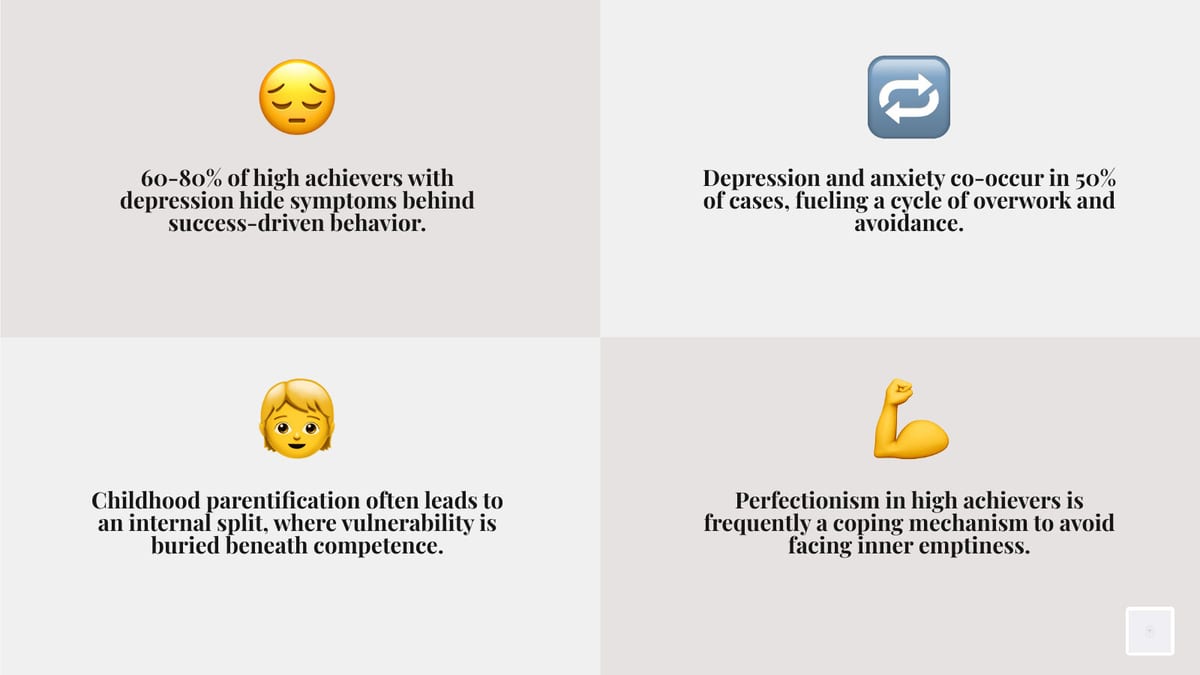
For many high achievers, the drive to succeed is not merely a professional goal; it is a survival mechanism. Many of these individuals experienced childhood parentification—a dynamic where a child is forced to take on the emotional or physical responsibilities of an adult. In these environments, love and security are often contingent upon being “useful” or “capable.”
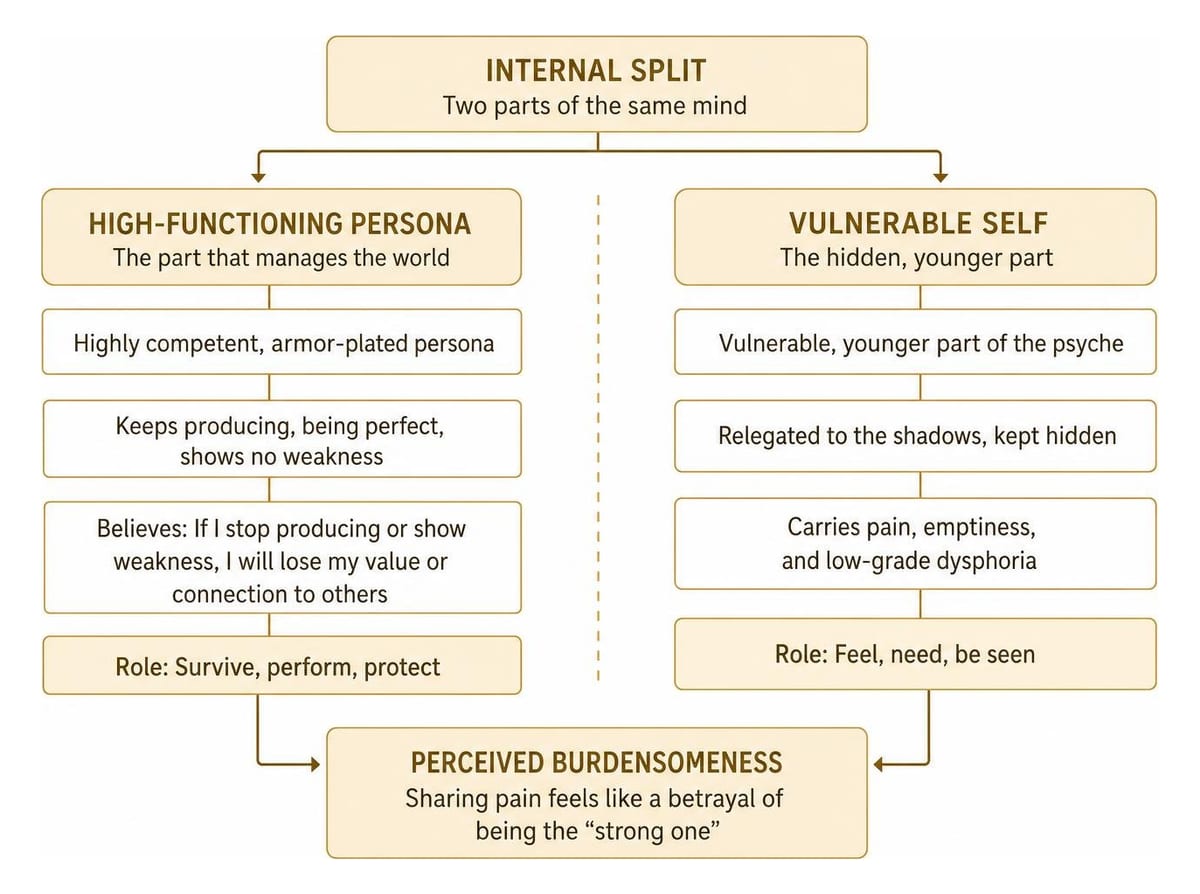
As adults, this manifests as an “internal split.” The individual develops a highly competent, armor-plated persona that manages the world, while a younger, vulnerable “part” of the psyche is relegated to the shadows. This split is protective. The high-achieving part of the brain believes that if it stops producing, if it stops being perfect, or if it shows weakness, it will lose its value or its connection to others. This creates a cycle of “perceived burdensomeness,” where the individual feels that sharing their pain would be a betrayal of their role as the “strong one.”
Perfectionism and the Cycle of Overwork
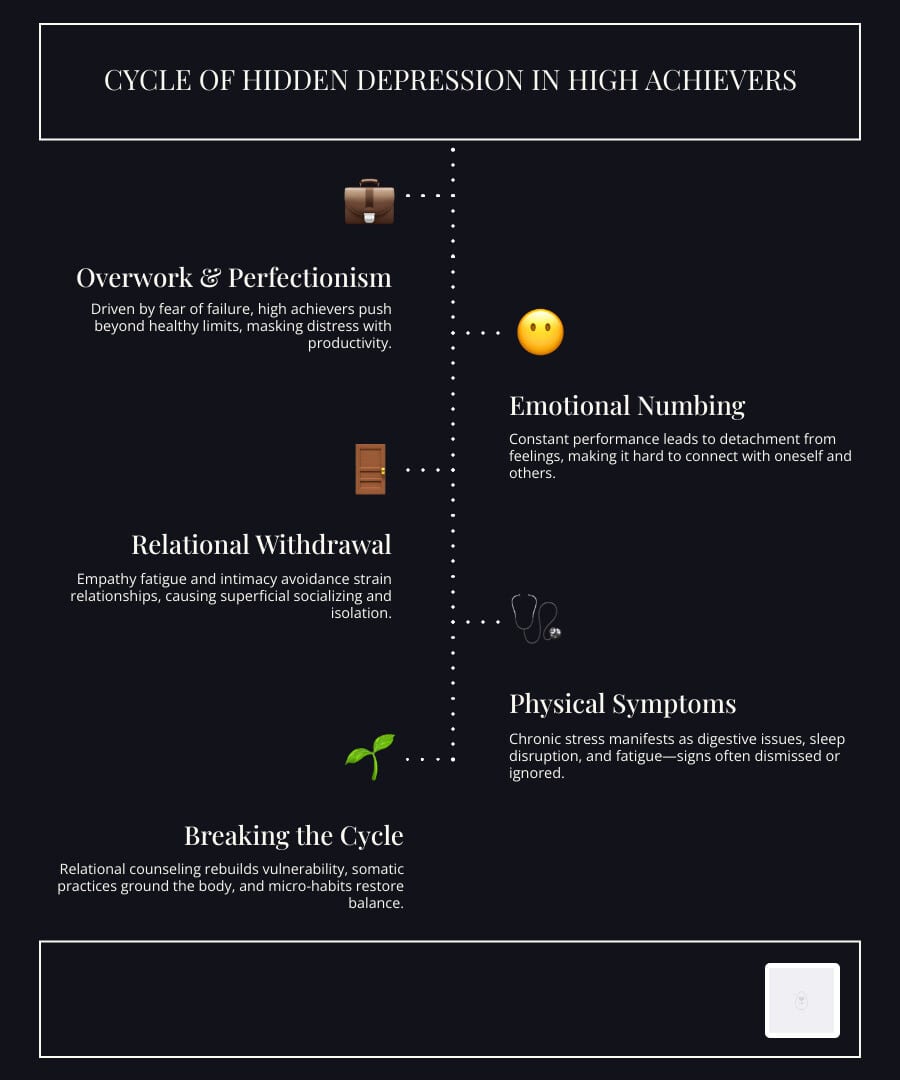
Perfectionism is frequently mislabeled as high ambition. However, in the context of hidden depression, perfectionism is often a form of avoidance. By keeping a schedule packed to the minute, the high achiever ensures there is no quiet space for the “emptiness” to surface.
We see a significant overlap here: there is a 50% comorbidity rate between depression and anxiety. This is not coincidental. Anxiety acts as the engine of activation—the “upregulation”—that forces the individual to keep moving, while the depression acts as the “downregulation,” the heavy, hollow feeling that remains even after the work is done. For many, the “billable hour” mindset—where time is only valuable if it is productive—extends into their personal lives. They treat their own mental health as a lost asset, fearing that taking time to rest or reflect is a sign of professional decline.
Recognizing the Overlooked Manifestations of Functional Depression
Because high achievers are experts at managing appearances, they often miss the subtle, internal cues that they are struggling. The body, however, is rarely as good at lying as the mind.
Feature Classic Depression High-Functioning Depression Primary Symptom Inactivity/Withdrawal Over-functioning/Busyness Self-Perception Feeling “broken” Feeling “not enough” Social Life Isolation Superficial engagement Motivation Loss of interest Driven by fear/perfectionism Somatic Dysregulation
When the brain suppresses emotional pain, it often leaks out through the body. Research indicates that 58% of high achievers report IBS-like symptoms, chronic headaches, or unexplained tension during high-pressure periods. These are not merely “stress”; they are the physical manifestations of a nervous system that is stuck in a chronic state of fight-or-flight.

Relationship Strain and Emotional Disconnection
Hidden depression acts as a barrier to intimacy. Because the individual is exhausted from “performing” wellness all day, they often return home to their partners with nothing left to give. This leads to “empathy fatigue,” where the individual can no longer process their partner’s needs because they are barely holding their own together. They may engage in superficial socializing—attending events and keeping up appearances—while feeling entirely isolated from the people they love.
Healing and Reconnection Through Relational Counseling
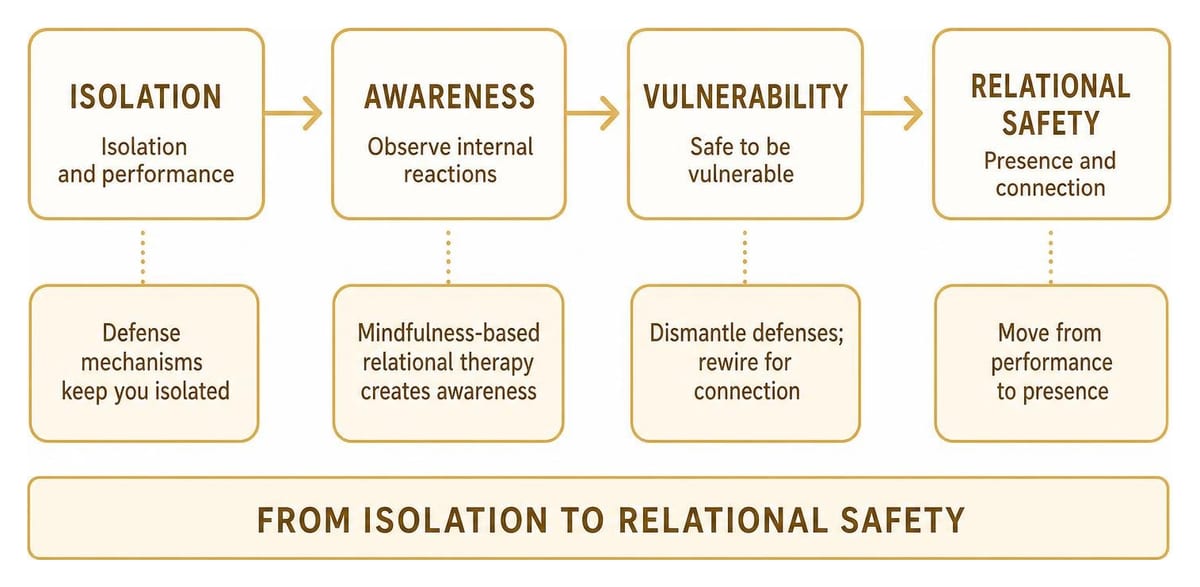
Healing for the high achiever does not mean giving up their ambition; it means moving from a state of “performance” to a state of “presence.” This is where relational approaches become transformative.
How Relational Counseling Rebuilds Vulnerability and Trust
Traditional, individual-focused therapy can sometimes reinforce the high achiever’s tendency to treat healing as another “project” to be completed. In contrast, relational counseling focuses on the space between people. By using mindfulness-based relational therapy, individuals learn to observe their internal reactions in real-time within the safety of the therapeutic relationship. This helps dismantle the defense mechanisms that keep them isolated. It teaches the brain that it is safe to be vulnerable, effectively rewiring neural pathways that have been hardened by years of self-reliance.
Integrating Relational Counseling with Somatic and Micro-Habits
We often tell our clients that they don’t need to overhaul their entire lives to start feeling better. We encourage “microdosing” self-care:
- Somatic Grounding: Taking three minutes to sit without a phone, focusing on the sensation of warmth or gravity.
- Boundary Setting: Learning to say “no” to non-essential tasks to preserve the nervous system.
- Vulnerability Practice: Sharing one “unpolished” thought with a trusted friend or partner each week to break the cycle of perfectionism.

Frequently Asked Questions about Relational Counseling and Hidden Depression
How does relational counseling help high achievers who feel they are not depressed enough?
High achievers often use their success as evidence that they are “fine.” Relational counseling helps dismantle this minimization by focusing on the internal experience rather than external output. We help clients understand that “functioning” is not the same as “thriving,” and that they do not need to hit a “rock bottom” to deserve support.
Can therapy help high performers heal without diminishing their drive?
Absolutely. The goal is not to remove the drive, but to change the fuel. When an individual stops using fear and perfectionism as fuel, they often find that their performance becomes more sustainable and creative. By integrating the “vulnerable self” with the “achieving self,” they gain access to a deeper, more intrinsic motivation that is less prone to burnout.
What are the earliest physical and relational signs that high achievement is masking depression?
Watch for “the crash”—the feeling of being completely unable to function the moment the work day ends. Other signs include digestive distress, the inability to enjoy hobbies that were once pleasurable, and a growing sense of irritation or detachment from partners and family members.
Conclusion: Reclaiming Authentic Connection and Well-Being
The most profound realization for many high achievers is that they do not have to carry the weight of the world alone. Your competence is a gift, but it was never intended to be a shield against your own humanity.

By acknowledging the internal split and choosing to engage in relational work, you are not admitting defeat; you are choosing longevity. You are choosing to move from a life of quiet survival to one of genuine, connected living. If you find yourself paddling hard against the tide, seeking support is the most courageous, high-achieving act you can perform. You deserve to be seen—not just for what you produce, but for who you are.