
It’s got to be out there. It doesn’t matter that Otodus megalodon has by all scientific accounts been extinct for more than 3 million years. The ongoing earthly presence of the enormous shark persists in our collective imagination thanks to rumors, legends, and summer B flicks.
Meg mythology often posits that the 50-foot predator has been hiding for epochs somewhere at the bottom of the ocean. It’s a notion that’s launched more than a few books and pseudo-docs, all hinging on the fact that most of the planet’s nether waters are unexplored—and therefore rife with primo dens for enigmatic beasts. But based on what we know of the biological adaptations required for life down below, not many animals could pull off a deep-sea disappearing act. If megalodon is still out there (and that’s a pretty big if), it’s not what it used to be.
Fossil shark teeth got people hooked on the Meg long before paleontology took off in the early 19th century, when scientists started cataloging fossils with gusto. In 1835, Swiss naturalist Louis Agassiz described triangular, finely serrated teeth, which had been found worldwide since antiquity, as belonging to a “megatooth” relative of the great white.
Discoveries around the world—in locations as diverse as Panama, Japan, Australia, and the southeastern United States—piled up over time, but one particular find raised the specter of a Meg still swimming in the deep. In 1875, during an expedition for the Royal Society of London, the HMS Challenger dredged up 4-inch-long teeth from a depth of 14,000 feet near Tahiti. In 1959, zoologist Wladimir Tschernezky, who made a hobby of researching “hidden animals” like Bigfoot, estimated the specimens were just 11,300 years old. Other scientists have since dismissed this dating, but unscrupulous documentarians and curious amateurs still highlight the research as a hint that Meg might persist.
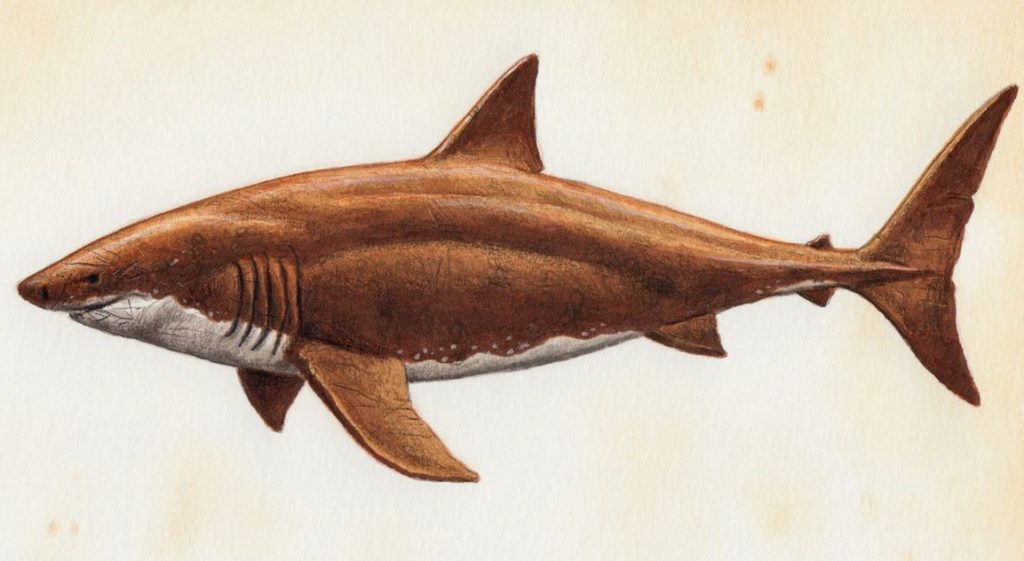
Save for the outliers found by the Challenger, the megalodon’s fossil record indicates it was a shore-hugging creature, similar to its distant cousin the great white. “Remains generally come from coastal marine rock deposits formed in tropical-temperate areas,” says DePaul University shark researcher Kenshu Shimada. The species’s dietary habits further confirm a shallow lifestyle, with gnawed ancient whale bones showing Meg’s preference for marine mammals. These air breathers had to break through the surface for oxygen, so paleontologists expect megalodon, like them, hung out near the shore.
People also read: Killer Whale Vs Great White – Orca Kills Shark and Wins Fight
The exact combination of factors that pushed the ancient shark into extinction is still murky. We do know that shallower oceanic zones were undergoing dramatic changes around 3.5 million years ago, when the giant disappears from the fossil record. Water was growing cooler, making marine mammals less abundant, and the newly evolved great white may have served as a nimble competitor for resources. But there’s no way to prove definitively what did in the Meg.
The lack of certainty helps some maintain hope of finding one in the deep. Believers have at least one thing right: The bottom of the sea is an enigma. Even though satellites have mapped 100 percent of its floor, a low-resolution chart alone doesn’t give us great insight into what actually lives there, says Louisiana Universities Marine Consortium Executive Director Craig McClain, who specializes in cataloging oceanic systems. While the idea of a deep-dwelling ancient creature is highly improbable, he says, the sliver of possibility is still tempting. Less imposing critters have indeed shown up unexpectedly; in 1938 biologists identified a living coelacanth—a species of fish presumed extinct for about 65 million years.
If the megalodon were living in the dark, inky depths, though, it would have had to become a very different sort of creature—one we might not find nearly as cinematic. For one thing, Shimada says, its ravenous metabolism would need to fundamentally change. Preliminary geochemical analysis of isotopes in remains, which can help scientists estimate the body temperature of prehistoric organisms, indicates that megalodon was “warm-blooded” in the same sense as the great white. That predator’s active ocean cruising generates enough body heat to keep it toastier than surrounding seawater, an effort that burns through the equivalent of about six pounds of flesh a day. Meg may have weighed as much as three times more, and would have presumably required proportional grub. Yet animals near the ocean floor have to get by on teensy scraps, preying on the scant species that live there or hoovering up biological detritus that sinks down from carcasses above.
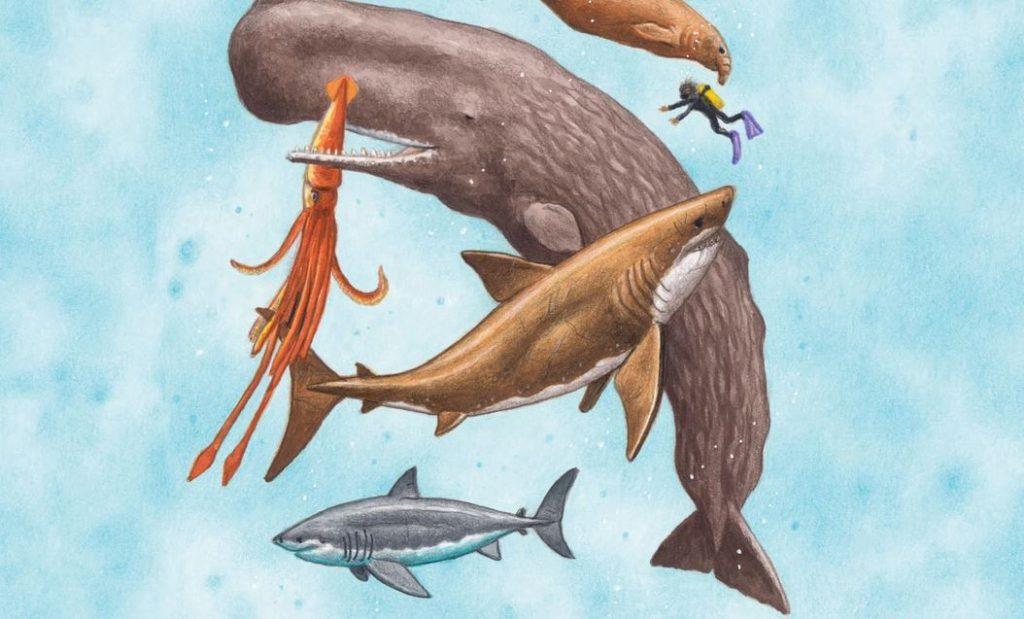
This scarcity of food tends to make organisms evolve small, efficient forms, making many low-living sharks relatively sluggish and slight. A megalodon living far enough down to evade human detection might now look something like a sleeping sperm whale or sleeper shark—a long, cigar-shaped animal that’s about as lively as it sounds—as opposed to a burly, toothy beast.
Yet even if Meg had assumed a slender and slow disguise, we’d probably have seen evidence of it by now. “Ocean giants that we do know about have global distributions,” McClain says. Even if we rarely spy creatures like giant squids, which live in the more forgiving upper ranges of what we’d call the deep sea, they leave markers of their existence strewn around the world in the form of carcasses (and bites taken out of unlucky critters). We’ve yet to spot any such refuse, if it even exists.
But these realities can’t extinguish the Meg’s enduring myth (and summer movie franchises). “As a deep-sea explorer and as a scientist who spends a lot of time researching known ocean giants, I really want there to be some unknown one that is undiscovered, and to make that discovery,” McClain says. Its mysterious nature—what we know of it comes largely from studying teeth—makes it enticing to imagine the Meg’s pulled off the ultimate vanishing act and could, perhaps, reemerge at any moment. The key is where scientists decide to look. While paleontologists are almost certain megalodon doesn’t swim in our modern seas, they might still find more details about the species in the depths of the fossil record—and its enduring secrets could break the surface when we least expect.
A History of the Megalodon
Megalodon fossils have been discovered worldwide, including Europe, Australia, Africa, and the Americas. Generally, megalodon occurred in subtropical and temperate latitudes.
Scientists have long believed that the great white shark is the closest relative of megalodon that even lived in the world at the same time. In modern scientific studies, megalodon was closer to mako sharks’ ancestor, small but fast fish-eating sharks.
Many people ask whether megalodons are dinosaurs or not. Even though dinosaurs and megalodons are both extinct, these two creatures never coexisted. While dinosaurs became extinct 66 million years ago, the megalodons existed later.
In addition, the most commonly asked question is “What wiped out megalodons?”. The great white shark may have wiped out megalodons, according to some research studies. However, scientists may have miscalculated the time of their death by 1 million years.
Take a look at the historical milestones of the megalodon:
16 million years ago – Otodus megalodon evolves from an ancestral group of megatooth sharks—the last member of a line that began 60 million years ago.
10 million years ago – The shark spreads to coastal waters worldwide. Clusters of baby teeth near Panama suggest nurseries were close to shore.
5 million years ago – Great white sharks evolve, and likely compete with the massive Meg to eat the same marine mammals, such as whales.
3.5 million years ago – Otodus megalodon seemingly goes extinct around a time of upheaval, including cooling seas and a dip in the species it munched on.
70 CE – Pliny the Elder notes that large “tongue stones” found in the rock strata of Europe may fall from the heavens during lunar eclipses.
1666 – Danish scientist Nicolas Steno dissects the head of a shark found off the coast of Italy and speculates that “tongue stones” are teeth.
1835 – Swiss naturalist Louis Agassiz coins the name Carcharodon megalodon in describing a set of the creature’s giant chompers.
1875 – The HMS Challenger dredges up megalodon teeth from the deep sea near Tahiti, fueling speculation about the shark’s survival.
1909 – Researchers build a model of a Meg jaw that fits six standing adults—suggesting an 80-foot body. This is now considered oversize.
1919 – Fishers in Australia claim to see a massive shark eat multiple lobster pots. The legend eventually makes its way into megalodon lore.
1974 – Peter Benchley publishes Jaws, which plays with the idea that a prehistoric man-eater might lurk in the deep. The public is hooked.
2016 – After decades of debate on the specifics of Meg’s family tree, the giant shark gets the new scientific name Otodus megalodon.
Conclusion
Megalodon or ancient mega sharks don’t exist in the modern era. At this point, there’s no conclusive evidence that they still do. While enormous sharks are still in the deep seas and great discoveries uncover the secrets and facts of mega sharks, there’s a long way to go to prove they’re still in the deepest waters.
This post originally appeared in Mysteries issue of Popular Science. Join https://www.popsci.com/newsletters/