
Key Takeaways Before We Dive In:
- Charging speed is now one of the most critical factors in EV adoption.
- Fast charging stations make EVs viable for daily commutes and long road trips.
- DC fast chargers offer grocery-shopping-level convenience by reducing charging time drastically.
- Battery health, charging infrastructure, and public accessibility are evolving fast.
- Fast charging boosts confidence, reduces range anxiety, and improves sustainability goals.
Electric Cars: Why Fast Charging Speed Is the Real MVP
Imagine being late for work and realizing your phone’s battery is at 5%. Now picture this same scenario with your car. Yup, it’s a panic-inducing situation. In the world of electric vehicles (EVs), this anxiety has a name—range anxiety, and charging speed is its worst enemy.
But what’s the big deal about charging speed anyway? Turns out, a lot. Let’s break it down like we’re chatting over coffee (or while your EV charges up in 20 minutes flat).
Charging Speed 101: Why Seconds Count More Than Miles
Charging an EV isn’t as simple as “plug it in and wait.” It’s a race against time. Charging speeds vary wildly, and that variation affects your daily lifestyle, road trip plans, confidence, and even your car’s battery life.
There are typically 3 levels of EV charging:
| Charging Level | Charging Speed | Approximate Range Added | Best For |
|---|---|---|---|
| Level 1 | 2-5 miles/hour | ~40-50 miles overnight | Emergency, overnight at home |
| Level 2 | 10-30 miles/hour | ~100-200 miles overnight | Daily use at home/work |
| DC Fast | 180-300+ miles/hour | 80% charge in ~20-40 min | Road trips, public stations |
The Convenience Factor: Daily Driving and Fast Charging
Alright, let’s talk about real life. Not everyone has a garage with a power plug. Many EV owners live in cities, apartments, or share parking spaces. For these folks, public fast charging is essential.
That’s where DC fast chargers become the MVP. You grab a sandwich, check your emails, and boom, your car is ready to roll. No four-hour waits. No charging drama. Just in, out, and on your way.
This is why charging convenience isn’t just a perk—it’s a necessity. If people feel charging is a hassle, they won’t switch to EVs.
Road Trips Reimagined: How Fast Charging Changed the Game
Gone are the days when EV drivers clutched the steering wheel, eyes glued to the battery gauge.
Fast charging means you can drive coast to coast without losing your mind. Need proof?
| Trip | Distance | Charging Stops | Time to Recharge with DC Fast Charging |
|---|---|---|---|
| LA to Vegas | 270 miles | 1-2 | ~25-35 mins total |
| NYC to Boston | 215 miles | 1 | ~20 mins |
| Dallas to Austin | 195 miles | 1 | ~15 mins |
According to a U.S. Department of Energy report, expanding fast charging along highways is key to supporting intercity EV travel. As new fast-charging corridors emerge across regions, spontaneous road trips and family vacations with electric cars are quickly becoming the norm.
Modern chargers now provide 80% charge in under 30 minutes. That’s enough time for a snack and bathroom break—something you’d do with a gas car anyway.
Public Charging Infrastructure: Built for Speed and Scale
Public fast chargers are not just about convenience—they’re also a smart business strategy.
- Higher Throughput: A fast charger serves multiple cars per hour.
- Business Appeal: Shopping centers and restaurants benefit from high turnover.
- Accessibility: Urban EV drivers rely on them as lifelines.
| Location Type | Average Session Time | Charging Level Used | Business Benefit |
|---|---|---|---|
| Shopping Mall | 25-35 mins | DC Fast | Foot traffic, sales bump |
| Highway Rest Stop | 20-30 mins | DC Fast | Restaurant revenue |
| Grocery Parking Lot | 30 mins | DC Fast/Level 2 | Retain customers longer |
As EVs scale, cities need charging networks that work for everyone—apartment dwellers, road-trippers, delivery drivers, and weekend warriors.
Range Anxiety: Beating the Fear One Fast Charge at a Time
Raise your hand if you’ve ever panicked when the gas light comes on. Now imagine that stress times ten. That’s range anxiety.
Fast charging crushes this fear.
- Can’t make it home? Plug in for 20 minutes.
- Taking a detour? There’s probably a station nearby.
- Battery dipping too low? Fast charging brings it back in minutes.
According to McKinsey, more than 50% of EV owners say charging availability directly affects how much they drive their EVs.
Fast charging frees people to use their cars however they want, whenever they want.
The Evolution of Charging Technology: Nerdy but Necessary
Charging speeds aren’t just getting better by accident. There’s a tech war happening behind the scenes.
| Technology Feature | Old Standard | Current/Advanced Feature |
|---|---|---|
| Battery Chemistry | Lithium-Ion Basic | Solid-State, LFP, NMC |
| Cooling System | Passive | Active Liquid Cooling |
| Charging Speed | <100 kW | 250 kW – 350+ kW |
| Vehicle Compatibility | Brand-Specific Ports | Universal CCS / NACS |
Modern batteries + thermal systems = faster, safer, longer-lasting EVs.
Fleet operators (like Uber, Amazon, FedEx) especially benefit from this because less time charging = more deliveries, more rides, and more $$$.
Charging Speed and Battery Health: What You Should Know
“Does fast charging kill my battery?” Great question. The answer: It depends.
Yes, extreme fast charging creates heat and chemical stress. But modern systems smartly regulate temperature and charging current.
Best practices for battery longevity:
- Mix it up: alternate fast and Level 2 charging.
- Avoid always charging to 100%.
- Don’t let battery dip below 10% too often.
This balanced approach lets you enjoy the speed of fast charging without ruining your battery’s vibe.
Charging Speed, Sustainability, and the EV Revolution
Fast charging doesn’t just make life easier—it makes the planet healthier.
- Quicker charging = more people adopting EVs.
- More EVs = fewer gas cars.
- Fewer gas cars = cleaner air.
Cities with higher fast charger availability have seen measurable drops in CO2 and NOx emissions.
And yes—fast chargers can pull power from solar, wind, and battery storage. Some stations already do. That’s a charging session powered by sunshine.
Future Directions: Fast Charging for Everyone
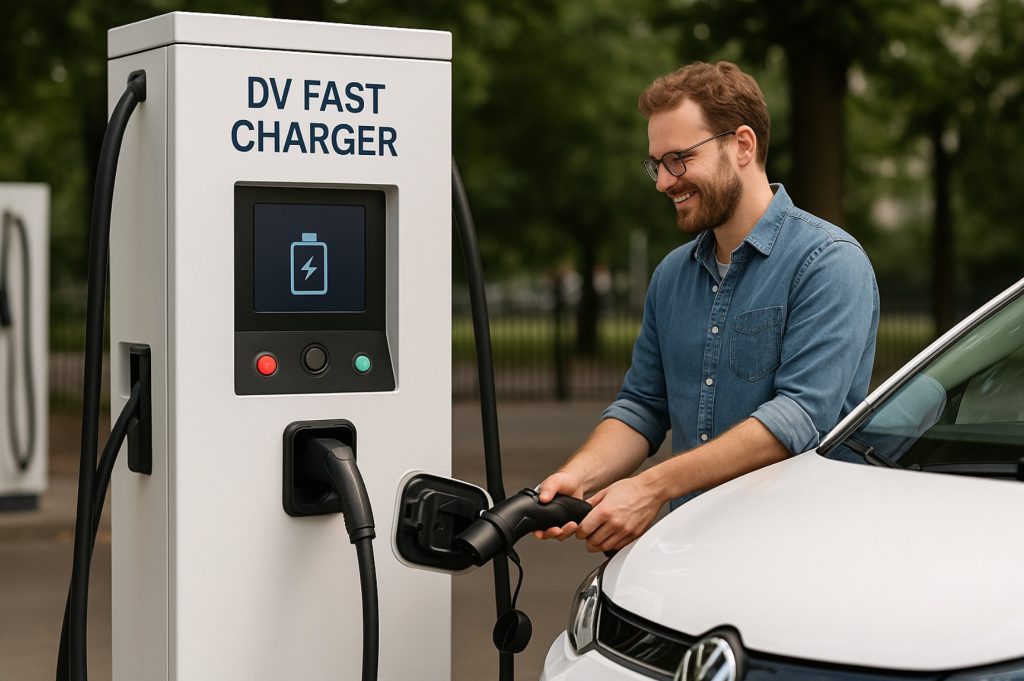
What’s coming next? Think faster, smarter, and more widely available.
Governments and private players are:
- Rolling out interoperable charging stations (like using any ATM).
- Funding rural and low-income area stations.
- Supporting tech innovations that reduce charging time below 10 minutes.
It’s not just about building stations—it’s about equity and access.
Picture this: A world where charging your EV takes less time than ordering a latte. We’re almost there.
Conclusion: Speed Isn’t Just Nice, It’s Necessary
We’ve entered the age where your car charges as quickly as your phone. Fast charging is not a luxury anymore—it’s a lifeline.
Whether you’re commuting, road-tripping, delivering pizzas, or picking up your kid from soccer practice, fast charging puts freedom, flexibility, and fun back into driving.
So the next time someone tells you EVs are inconvenient, ask them: “Ever filled your tank in under 30 minutes while munching on a burrito?”
References:
- U.S. Department of Energy, 2023 EV Infrastructure Report
- McKinsey & Company, Electric Vehicle Consumer Survey 2022
- International Energy Agency, EV Outlook 2023
- Bloomberg New Energy Finance, 2024 EV Infrastructure Insights
- National Renewable Energy Laboratory (NREL)