
How violent strikes, Depression-era job-sharing policy, and wartime fatigue studies built the modern work schedule.
If technological advances have multiplied output per worker tenfold over the past century, why does the global economy remain anchored to an eight-hour day and a five-day week? The standard schedule did not arrive because industrial engineers calculated forty hours as the biological peak of human performance.
Why do we have a 40 hour work week? The modern standard was created through militant labor strikes, Great Depression job-sharing policies, and the Fair Labor Standards Act of 1938.1 Rather than outlawing long hours, federal lawmakers established a statutory overtime penalty to make excessive shifts financially punitive, encouraging companies to distribute scarce work across larger payrolls.
For operations directors managing plant floors, logistics hubs, or continuous manufacturing rosters, that statutory ceiling dictates every shift rotation, overtime reserve budget, and staffing model. Understanding the evolution of industrial time requires exploring labor history not as a static record of decrees, but as a living negotiation over human limits.
1886–1894: Chicago’s Strikes and the Fight for Eight Hours
The drive toward a restricted working day originated as a defensive union revolt against punishing twelve-hour shifts rather than a negotiated corporate benefit. In the smoking rail yards and foundry corridors of late-nineteenth-century Chicago, heavy manufacturing ran on raw physical endurance. Industrialists operated equipment ten to sixteen hours a day, six days a week. When market demand swung downward, factories trimmed hourly pay rather than daily operating times, expecting workers to absorb the physical shock.
Discontent reached a flashpoint in the spring of 1886. On May 1, 1886, approximately 35,000 workers walked off their jobs in Chicago during a nationwide strike demanding an eight-hour standard workday. That mass walkout paralyzed the city’s freight hubs and agricultural machinery plants, sparking days of street confrontations that culminated in the deadly Haymarket Affair on May 4. The subsequent state crackdown shattered organized labor leadership in the city, but the demand for an eight-hour limit became an international rallying cry.
Eight years later, Chicago became the epicenter of another explosive clash over working conditions and overhead. In May 1894, nearly 4,000 workers launched a wildcat strike after management cut wages by approximately 25% at the Pullman Palace Car Company on the city’s South Side, while refusing to lower residential rents in company-owned housing. The resulting rail boycott disrupted national passenger and freight traffic across twenty-seven states.
Facing economic gridlock, political leaders scrambled to contain the rebellion before sending in armed force. On June 28, 1894, President Grover Cleveland and the U.S. Congress enacted legislation establishing Labor Day as a national holiday to mollify public anger, days before federal troops entered Chicago to break the strike with bayonets and rifles. The eight-hour day was not granted through executive goodwill. It was hammered out in industrial corridors where uninterrupted production collided with street-level disruption.
- May 1, 1886 — Around 35,000 workers strike across Chicago demanding an eight-hour day, initiating the mobilization that ended in the Haymarket Affair.
- June 28, 1894 — The federal government establishes Labor Day as a statutory holiday during the Pullman rail strike.
- January 1914 — Ford Motor Company cuts shift lengths from nine to eight hours while doubling plant wages to US$5 per day for a six-day week.
- September 3, 1916 — The Adamson Act sets an eight-hour standard day and overtime pay for interstate railroad operators.
- May 1, 1926 — Ford Motor Company shifts 55,000 factory employees to a five-day, 40-hour work schedule.
- December 1, 1930 — Cereal maker W.K. Kellogg converts his Battle Creek plant to four six-hour shifts, introducing a 30-hour workweek.
- April 6, 1933 — The U.S. Senate passes the Black Thirty-Hour Work Week Bill by a 53 to 30 vote.
- June 25, 1938 — President Franklin D. Roosevelt signs the Fair Labor Standards Act, mandating a phased transition to 40 hours by October 24, 1940.
- February 3, 1941 — The U.S. Supreme Court upholds federal statutory work hours in United States v. Darby.
1914–1926: Henry Ford and the Pragmatics of Factory Retention
Henry Ford shortened factory shifts not out of personal philanthropy, but to solve an operational retention crisis and build consumer demand for his vehicles. Operations leaders must dismantle the corporate folklore surrounding the assembly line. Ford did not gift his workers free weekends out of the kindness of his heart.
In January 1914, Ford made headlines by announcing a US$5 per day wage and reducing shift lengths from nine to eight hours. What popular memory omits is that this 1914 reform maintained a six-day, 48-hour schedule. The moving assembly line at Highland Park had accelerated output, but it broke human bodies. Skilled mechanics walked off the line in droves, forcing plant supervisors to run constant recruitment pipelines just to keep basic assembly stations manned. Paying higher wages for eight-hour shifts stabilized daily staffing and slashed line downtime.
The transition to a five-day schedule arrived twelve years later. On May 1, 1926, Ford instituted a five-day, 40-hour workweek for approximately 55,000 factory employees, keeping the daily US$6 minimum wage intact. Ford’s rationale was straightforward economics. Continuous mass production required mass consumption. Factory workers chained to machines for six full days each week had no opportunity to purchase consumer goods, burn motor fuel, or take recreational weekend trips in Model Ts.
Federal intervention in private-sector scheduling followed a parallel path of commercial necessity. On September 3, 1916, Congress passed the Adamson Act, mandating an eight-hour standard workday and overtime pay for interstate railroad operators. The law was designed to avert a nationwide rail strike that threatened to shut down industrial freight distribution. When challenged by railroad executives, the U.S. Supreme Court sustained the statute under the Commerce Clause, setting the legal precedent that the federal government held constitutional authority to regulate shift lengths in private commerce.2
1930–1940: Frances Perkins, Job-Sharing, and the Fair Labor Standards Act
The Great Depression transformed the regulation of working hours into a federal job-sharing strategy intended to ration scarce employment across a collapsing economy. When consumer spending plummeted and industrial plants shuttered across North America and Europe, political leaders confronted systemic unemployment that threatened social order. Shorter hours were viewed not as a luxury for workers, but as a mechanical lever to spread available labor hours across more individual households.
Some industrial pioneers acted independently. On December 1, 1930, cereal manufacturer W.K. Kellogg reorganized his Battle Creek, Michigan plant from three 8-hour shifts to four 6-hour shifts, creating a 30-hour workweek. By shortening the workday, Kellogg added 300 to 400 workers to his payroll, reduced plant overhead through eliminated meal breaks, and achieved higher hourly output per employee. The six-hour shift proved that shorter schedules could maintain plant volume while expanding headcount.
Federal lawmakers soon pushed for mandatory work reductions. On April 6, 1933, the United States Senate passed Senator Hugo Black’s Thirty-Hour Work Week Bill by a vote of 53 to 30. The aggressive bill sought to bar from interstate commerce any manufactured goods produced by employees working more than six hours a day or five days a week. While the measure alarmed corporate federations and stalled in the House of Representatives, it demonstrated that an even shorter standard was under active consideration.
The compromise that established forty hours as the national ceiling was engineered by Frances Perkins. When President Franklin D. Roosevelt invited Perkins to serve as Secretary of Labor in 1933, she agreed on the explicit condition that the administration support federal minimum wages and maximum hour legislation. Perkins recognized that a rigid 30-hour cap lacked the operational flexibility required by diverse industrial sectors, proposing instead a statutory overtime penalty.
The result was the Fair Labor Standards Act (FLSA), signed into law in June 1938. The statute established a staged reduction in the standard workweek, starting at 44 hours in 1938, lowering to 42 hours in 1939, and settling permanently at 40 hours on October 24, 1940. The legislation did not strictly ban work beyond forty hours. Instead, it mandated that covered employers pay non-exempt staff at least one and one-half times their regular pay rate for excess hours.
The Fair Labor Standards Act was designed not as an absolute ceiling on human effort, but as a targeted tax on overtime to compel hiring.
The statutory shield was narrow at inception. In 1938, the FLSA applied only to industries engaged in interstate commerce, protecting roughly 20 percent of the total American workforce while excluding agricultural, domestic, and local retail personnel. Any constitutional uncertainty evaporated in 1941 when the U.S. Supreme Court ruled unanimously in United States v. Darby that Congress possessed full authority under the Commerce Clause to govern industrial hours and wages.
1941–1947: Wartime Factory Output and the Limits of Efficiency
Wartime industrial studies revealed that extending shifts beyond forty-eight hours yielded diminishing production returns while driving up scrap rates and workplace casualties. With the outbreak of World War II, manufacturing directors abandoned standard schedules in an all-out drive to equip allied forces. Round-the-clock aircraft plants, tank arsenals, and naval shipyards pushed employee shifts to fifty, sixty, and seventy hours per week, assuming that total output would rise in direct proportion to logged hours.
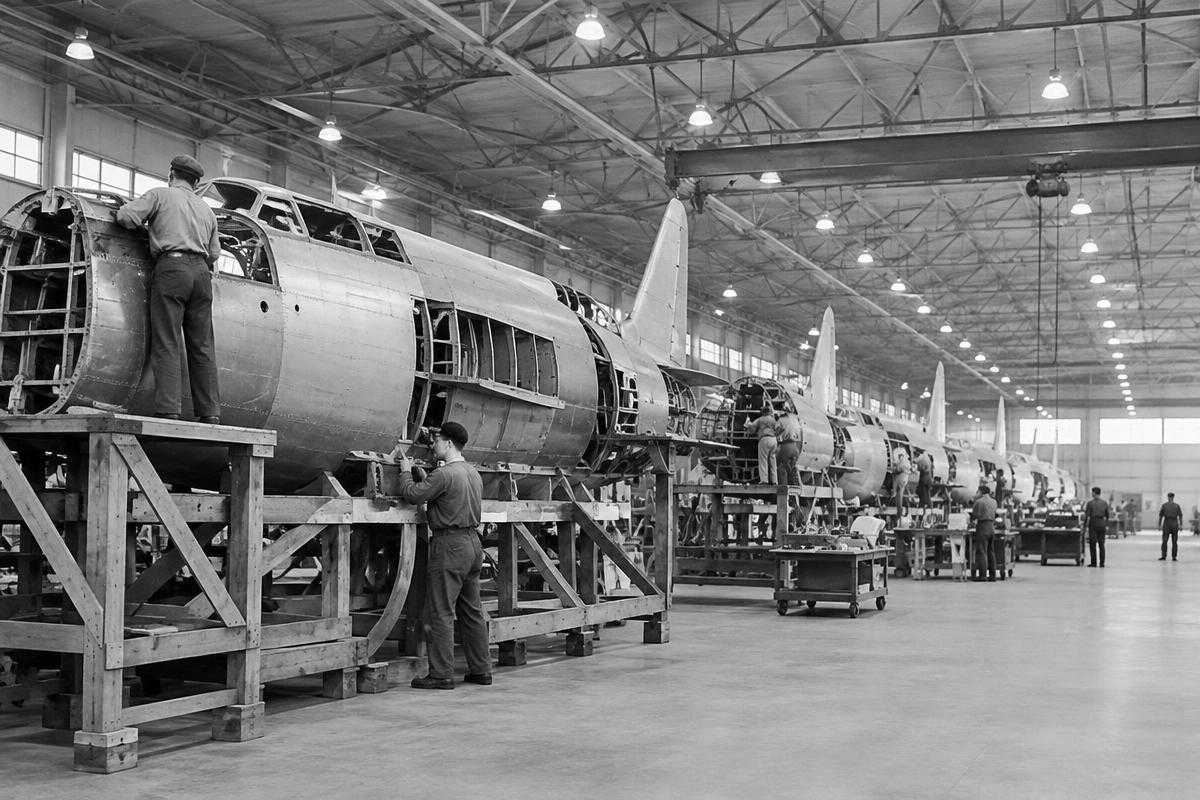
Industrial engineers quickly ran into physiological limits. Field research conducted across manufacturing facilities during the war documented a recurring pattern. When shift schedules expanded past forty-eight hours, hourly efficiency deteriorated steadily. Workers battling chronic sleep deficits produced higher defect rates, damaged specialized machinery, and experienced sharp increases in industrial accidents and unplanned absenteeism.
The comprehensive post-war analysis published by the U.S. Bureau of Labor Statistics confirmed that extended schedules were counterproductive over sustained operating cycles. In machining and assembly operations requiring physical concentration, the work completed during extra overtime hours was routinely offset by ruined components, assembly line delays, and safety incidents. Factory directors discovered an unyielding operational reality: paying a 50% overtime wage premium for tired staff operating during their fiftieth or sixtieth weekly hour yielded declining net production and higher cost per finished unit.
1948–Present: Why the Workweek Froze Across the Global Economy
Postwar fringe benefit liabilities permanently anchored the forty-hour standard in the United States by making overtime for existing staff cheaper than hiring new employees. As mechanical automation, computerization, and containerized logistics multiplied output per hour in the late twentieth century, economists predicted that working hours would drop to thirty or twenty hours. Instead, the statutory forty-hour schedule froze in place.

The structural lock-in stemmed from the economics of employee benefits. In the decades following 1945, compensation packages shifted away from pure hourly wages toward employer-funded health insurance, pension contributions, disability coverage, and mandatory payroll taxes. These fringe benefits acted as fixed head-count costs. Onboarding an additional worker required paying thousands of U.S. dollars in fixed overhead regardless of hours worked. As a result, paying an existing worker time-and-a-half overtime up to forty-eight hours was frequently cheaper than adding another employee to the payroll.
| Country | Governing Statute | Standard Weekly Baseline | Statutory Overtime / Maximum Cap |
|---|---|---|---|
| United States | Fair Labor Standards Act (1938) | 40 hours | No statutory cap; 1.5x regular pay after 40 hours |
| Canada | Canada Labour Code (Part III) | 40 hours (8 hours/day) | 48 hours statutory maximum weekly cap3 |
| Australia | Fair Work Act 2009 (Sec. 62) | 38 ordinary hours | Additional hours must satisfy test of reasonableness |
| United Kingdom | Working Time Regulations 1998 | Determined by contract | 48-hour average over 17 weeks (individual opt-out allowed) |
| Singapore | Employment Act (Part IV) | 44 hours | Overtime capped at 72 hours per month |
Sources: Fair Labor Standards Act (United States); Canada Labour Code (Canada); Fair Work Act 2009 (Australia); Advisory, Conciliation and Arbitration Service (United Kingdom); Employment Act (Singapore).
Across major English-speaking economies, statutory baselines diverged around this industrial median. Under Section 62 of Australia’s Fair Work Act 2009, full-time staff cannot be required to work more than 38 ordinary hours per week unless the additional hours are proven reasonable. In Canada, Part III of the Canada Labour Code establishes standard hours at 8 hours per day and 40 hours per week, imposing a strict maximum cap of 48 hours for federally regulated sectors.
In the United Kingdom, the Working Time Regulations 1998 capped the average workweek at 48 hours over a 17-week reference period, though it preserved an individual written opt-out mechanism. Meanwhile, Singapore’s Employment Act sets standard working hours at 44 hours per week, capping monthly overtime at 72 hours.4
In the United States, the federal baseline remained remarkably static. A 2024 analysis of Current Population Survey data by the U.S. Government Accountability Office (GAO) found that average U.S. work hours remained stable at 38 to 39 hours per week between 2003 and 2023. That overall average, however, obscures a growing structural divide. The GAO noted that workers logging 55 or more hours per week were heavily concentrated in high-wage tiers holding bachelor’s degrees—roles generally classified as exempt from FLSA overtime protections.
2026 and Beyond: Biometrics, Burnout, and the Four-Day Debate
Modern clinical epidemiology and multinational corporate pilots have shattered the assumption that forty hours represents an immutable biological or operational optimum. For operations executives from the Millennial cohort (born 1981–1996, now aged 30–45, though generational boundaries vary by a few years across sources), managing facilities caught between legacy shift templates and remote digital connectivity has exposed structural strain on both physical and white-collar personnel.
The physiological toll of extended hours is no longer theoretical. A joint global study by the World Health Organization and the International Labour Organization found that working 55 or more hours per week is associated with a 35% higher risk of stroke and a 17% higher risk of dying from ischemic heart disease compared to working 35 to 40 hours. In manufacturing environments and distributed logistics operations, chronic fatigue manifests directly in slower reaction times, higher recordable incident rates, and costly inventory rework.
Recent international trials have tested whether reducing scheduled hours harms overall enterprise output. In the world’s largest four-day workweek pilot evaluated by researchers at Cambridge University and Boston College across 61 UK organizations, 92% of participating companies chose to continue the 32-hour schedule, while employee burnout fell by 71%. Participating organizations maintained operational revenues while documenting sharp decreases in staff turnover and sick leave.

Yet for senior operations directors, blanket schedule reductions introduce difficult operational trade-offs. Compressed work schedules like four 10-hour shifts are fundamentally distinct from true 32-hour work reductions. In automated distribution centers and physical assembly lines, accident frequencies climb sharply during the ninth and tenth hours of a physical shift due to cumulative neuromuscular fatigue. Additionally, in asset-heavy, continuous 24/7 manufacturing plants, moving from a 40-hour baseline to 32 hours requires an immediate 25% expansion in headcount to maintain three-shift coverage, an impossibility in industrial regions suffering persistent skilled-labor deficits.
Compensation dynamics create another operational friction point. Hourly plant workers who depend on overtime premiums to counter persistent consumer price inflation often resist strict schedule caps unless base hourly compensation rises to offset lost hours. In corporate engineering and supply chain offices, salaried managers exempt from overtime protections under the FLSA duties test face constant off-the-clock digital messaging, effectively inflating forty-hour contracts into sixty-hour realities without statutory recourse.
The statutory forty-hour workweek was forged as an emergency tool to resolve nineteenth-century street strikes and 1930s industrial collapse. What operations leaders must watch next is whether impending labor battles over FLSA executive salary exemption thresholds, municipal right-to-disconnect laws, and sector-specific scheduling mandates will finally fracture the eighty-year-old compromise, or whether the economics of fixed benefit overhead will keep forty hours frozen in place for another generation.
Keep reading on ReckonTalk
- Did You Know? Our Ancestors Nearly Faced Extinction 900,000 Years Ago!
- 12 Facts About “Rani Lakshmi Bai” Jhansi Ki Rani | Greatest Women Warrior Of India
- Did the Nazis practice magic ? | History
Notes
- This framing presents a US-specific legal origin as universal; other jurisdictions in the target readership established different standards (such as Australia’s 38 ordinary hours and Singapore’s 44 hours) through distinct domestic statutes. ↩
- In Wilson v. New (1917), the Supreme Court affirmed that congressional authority over interstate commerce extended to emergency hours and wage regulations for private railroad operators. ↩
- Part III of the Canada Labour Code applies only to federally regulated industries (roughly 6% to 10% of Canadian workers); the vast majority are governed by provincial employment standards acts with differing standard hours and thresholds. ↩
- In the UK, individual employees may opt out of the 48-hour statutory weekly limit in writing, a mechanism with no direct counterpart under US federal wage law. ↩
Sources
- Legal Information Institute, Cornell Law School. “29 U.S. Code § 207 – Maximum hours.” Accessed November 25, 2026. govinfo.gov.
- U.S. Department of Labor. “Fair Labor Standards Act of 1938: Maximum Struggle for a Minimum Wage.” Accessed November 25, 2026. dol.gov.
- U.S. Department of Labor. “Fair Labor Standards Act of 1938: Maximum Struggle for a Minimum Wage.” Accessed November 25, 2026. federalregister.gov.
- U.S. Government Accountability Office. “Research Shows That Very Long Hours May Modestly Increase the Risk of – GAO.” Accessed November 25, 2026. gao.gov.
- World Health Organization. “Long working hours increasing deaths from heart disease and stroke: WHO, ILO.” Accessed November 25, 2026. who.int.
- Annenberg Classroom. “Adamson Act Sets 8-Hour Work Day for Rail Workers.” Accessed November 25, 2026. en.wikipedia.org.
- Encyclopaedia Britannica. “Pullman Strike | Causes, Result, Summary, & Significance.” Accessed November 25, 2026. en.wikipedia.org.
- Advisory, Conciliation and Arbitration Service (Acas). “The 48-hour weekly maximum – Working time rules.” Accessed November 25, 2026. acas.org.uk.
- Cambridge University Press. “Kellogg’s Six-Hour Day: A Capitalist Vision of Liberation through Managed Work Reduction.” Accessed November 25, 2026. context.org.
- Chicago History Museum. “The Haymarket Affair.” Accessed November 25, 2026. chicagohistory.org.
- Fair Work Ombudsman. “Full-time employees.” Accessed November 25, 2026. professionalsaustralia.org.au.
- Government of Canada. “Hours of work – Federally regulated workplaces.” Accessed November 25, 2026. expatica.com.
- Jacksonville State University Digital Commons. “The Senatorial Years of Hugo Black.” Accessed November 25, 2026. encyclopedia.com.
- Ministry of Manpower Singapore. “Hours of work, overtime and rest day.” Accessed November 25, 2026. igrow.co.
- Oyez. “United States v. Darby.” Accessed November 25, 2026. oyez.org.
- Teaching American History. “Henry Ford’s Five-Day Week.” Accessed November 25, 2026. teachingamericanhistory.org.
- U.S. Department of Labor. “Fair Labor Standards Act of 1938: Maximum Struggle for a Minimum Wage.” Accessed November 25, 2026. pennycalc.com.
- University of Cambridge. “Would you prefer a four-day working week?.” Accessed November 25, 2026. 4dayweek.com.