
Key Takeaways:
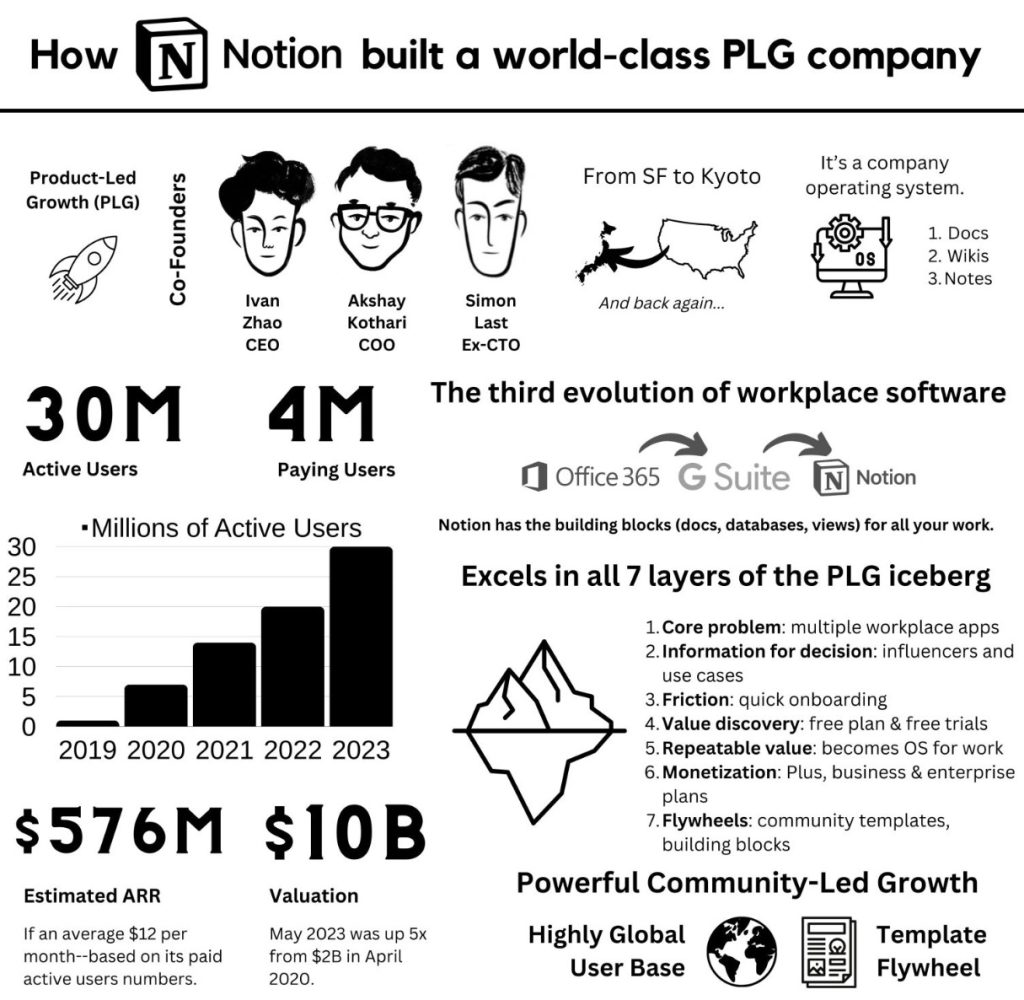
- Notion is a productivity platform that evolved from a failed startup to a company valued at over $10 billion.
- The founders, Ivan Zhao and Simon, overcame challenges by focusing on user needs rather than their own vision.
- Product-Led Growth (PLG) was key to Notion’s success, emphasizing the product’s functionality over traditional sales tactics.
- Notion’s multi-functional design—combining notes, wikis, and Kanban boards—differentiated it from competitors.
- With 500 employees, only 10% are dedicated to sales, yet Notion generates over $567M ARR.
The Wild Journey of Notion: From Coding in Underwear to a $10 Billion Empire
Imagine starting with just a $150K loan from your mom and building a company worth over $10 billion. This is the story of Notion, a productivity and collaboration tool that’s used by millions today. But this journey wasn’t smooth. It began with failure and turned into a global success. Let’s break down this fascinating story and uncover what made Notion the powerhouse it is today.
Chapter 1: The Birth of Notion – Rising from a Failed Startup
In 2015, Ivan Zhao and Simon, Notion’s co-founders, faced a big setback. Their no-code startup idea completely flopped. The lesson? They were too focused on what they wanted to bring to the world, not on what the world wanted from them. That’s a tough pill to swallow when you’re pouring your heart into something. So, what did they do?
They packed their bags and moved to Kyoto, Japan. Why? To get away from distractions and focus on their next big idea—this time, they had to get it right. With $150,000 loaned by Ivan’s mom, they spent a full year coding. And boy, did that year pay off!
In 2016, they launched Notion 1.0—and it was an instant hit on Product Hunt. The world finally noticed, and their persistence was rewarded. It was clear that Notion was different from other productivity tools that had flooded the market, like Miro, Canva, and Coda.
Example:
At the time, tools like Confluence dominated the wiki space. But Notion, with its clean design and accessible features, catered to a wider audience. People loved it because it wasn’t just for developers—it was for anyone who needed to get organized.
Chapter 2: Finding Product-Market Fit – Wikis and More
After the initial success, Notion began honing in on what users really wanted: docs, wikis, and tasks. But it was their wiki feature that truly struck a chord. Unlike Confluence, which was more technical, Notion was designed for everyone. It was user-friendly, affordable, and easy to adopt.
In 2018, Notion 2.0 launched, and with it came an even more robust offering. By combining notes and Kanban boards, Notion created a one-stop workspace. This was a game changer! Suddenly, people didn’t need a dozen different apps to get their work done—they had everything they needed in one place.
Data Point:
By 2018, Notion had gained over 1 million users. This growth was organic—users loved the product so much that they shared it with friends and colleagues without being asked.
Chapter 3: Building a Product-Led Growth Machine
In 2019, Notion finally took in outside investment. But here’s the kicker—they did it on their own terms. They raised $10 million at an $800 million valuation, while still retaining control over the company. That’s rare in the startup world!
Instead of hiring a large sales team, they focused on Product-Led Growth (PLG). The idea behind PLG is simple: let the product do the selling. If your product is great, people will use it, talk about it, and recommend it to others. And this worked perfectly for Notion.
They didn’t rely on aggressive sales tactics. Instead, they hired product experts—people who knew how to make the user experience better, which kept users coming back for more.
Data Table: Comparison of Notion’s Growth with Competitors (2019)
| Company | Revenue (2019) | Employee Count | Sales Team % | PLG Focus |
|---|---|---|---|---|
| Notion | $10M ARR | 50 | 10% | High |
| Asana | $50M ARR | 400 | 30% | Medium |
| Trello | $75M ARR | 300 | 25% | Medium |
Notion’s focus on product excellence set them apart from competitors who relied more heavily on traditional sales tactics.
Chapter 4: Where Are They Now?
Fast forward to today. Notion has grown to over 500 employees, but here’s what’s amazing—only 10% of them work in sales! They continue to stick with their Product-Led Growth strategy, and it’s paying off in a big way. Notion now has 30 million active users and generates an astounding $567M in annual revenue.
To put that into perspective, Asana, which operates in a similar space, generates only $167M. Clearly, Notion has carved out a unique position in the market, and it’s only a matter of time before they go public.
Comparison:
Let’s compare Notion to a few other platforms in the productivity space:
| Platform | Users (in millions) | Revenue (in millions) | Sales Team Size |
|---|---|---|---|
| Notion | 30 | $567 | 50 |
| Trello | 25 | $100 | 75 |
| Asana | 18 | $167 | 120 |
It’s clear that Notion’s unique approach has allowed them to grow quickly without needing an army of salespeople.
Part 2: The 7 Layers of Notion’s Growth Strategy
So, what’s the secret behind Notion’s explosive growth? It’s all about their 7-layer Product-Led Growth (PLG) strategy. Let’s break it down:
1. Build an Intuitive Product
Notion’s design makes it easy for users to jump in and start using the product without a steep learning curve. It’s visually appealing and organized.
2. Focus on Users’ Needs
From day one, Notion listened to what users wanted, not what they thought was cool. This mindset shift is what turned them into a success story after their first idea flopped.
3. Community Building
Notion has one of the most loyal user bases, thanks to their community-driven approach. They engage directly with users, taking feedback seriously.
4. Affordable Pricing
By offering a free version alongside more robust paid plans, Notion made sure it was accessible to everyone—from individuals to large teams.
5. Cross-Platform Integration
Notion can be integrated with a host of other tools like Slack, Google Drive, and Trello, making it a seamless addition to any workflow.
6. Virality
Users love Notion so much they recommend it to their peers. This organic word-of-mouth has been one of the most powerful drivers of growth.
7. Constant Innovation
Notion continuously releases new features, ensuring they stay ahead of the curve. Innovation keeps users excited and engaged.
Conclusion: The Future of Notion
Notion’s journey from failure to billion-dollar success is nothing short of inspirational. It’s a lesson in perseverance, listening to your users, and focusing on the product above all else. As they continue to grow, it’s clear that Notion isn’t just another productivity tool—it’s a game changer in how we work and collaborate.
Looking ahead, the question isn’t if Notion will go public but when. With their solid growth strategy and unwavering focus on user experience, the sky’s the limit.
References:
- Business Insider, “How Notion Became a $10 Billion Startup,” 2023.
- TechCrunch, “Notion Raises $10 Million at $800 Million Valuation,” 2019.
- Product Hunt, “Notion: The All-in-One Workspace,” 2016.